

Plenty of decks around Salmon Creek went in with the subdivisions twenty and thirty years back, and a lot of them are now letting go at the ledger and the footings. They look out over a greenbelt, a bend of the creek, or a territorial slice past the firs, and they sit in shade that drops needles and grows moss while the rain runs from October into June. The enemy here is not wind. It is damp that never fully clears. We build and rebuild decks and patio covers for exactly that, and since wood rot repair is what we do best, we can usually tell you how the old one gave out.
Licensed and insured. WA Lic. #EVERGRS757MC
On anything sent before 5pm
We match or beat most written estimates
Remodels completed
Footings, posts and beams, joists, the decking, a stair run and the rail, all flashed for the long wet season, your pick of cedar or composite.
If there is still life in the framing, a fresh surface goes on over it. If the wet has run too far through it, we pull it out and rebuild from the footings.
A solid roof set over the patio and flashed to the wall, so the space still works when December turns wet.
The footings, the posts and beams above them, and the ledger that ties the whole load back to the house.
Railings on 1980s to 2000s decks were built to the rules of their day, so we pull them, inspect each post and bolt, and tighten or reinforce any connection that has loosened. The new rail meets current code for how tall a guard stands and how closely its balusters are spaced. Your frame and decking stay right where they are.
The frame is the part you never see again once the boards go down. This is the same deck at both stages.
Drag the handle. Left, the deck framed: joists on the beam, nothing to walk on yet. Right, the same deck finished, with the timber cover over it and the steps down to the yard.
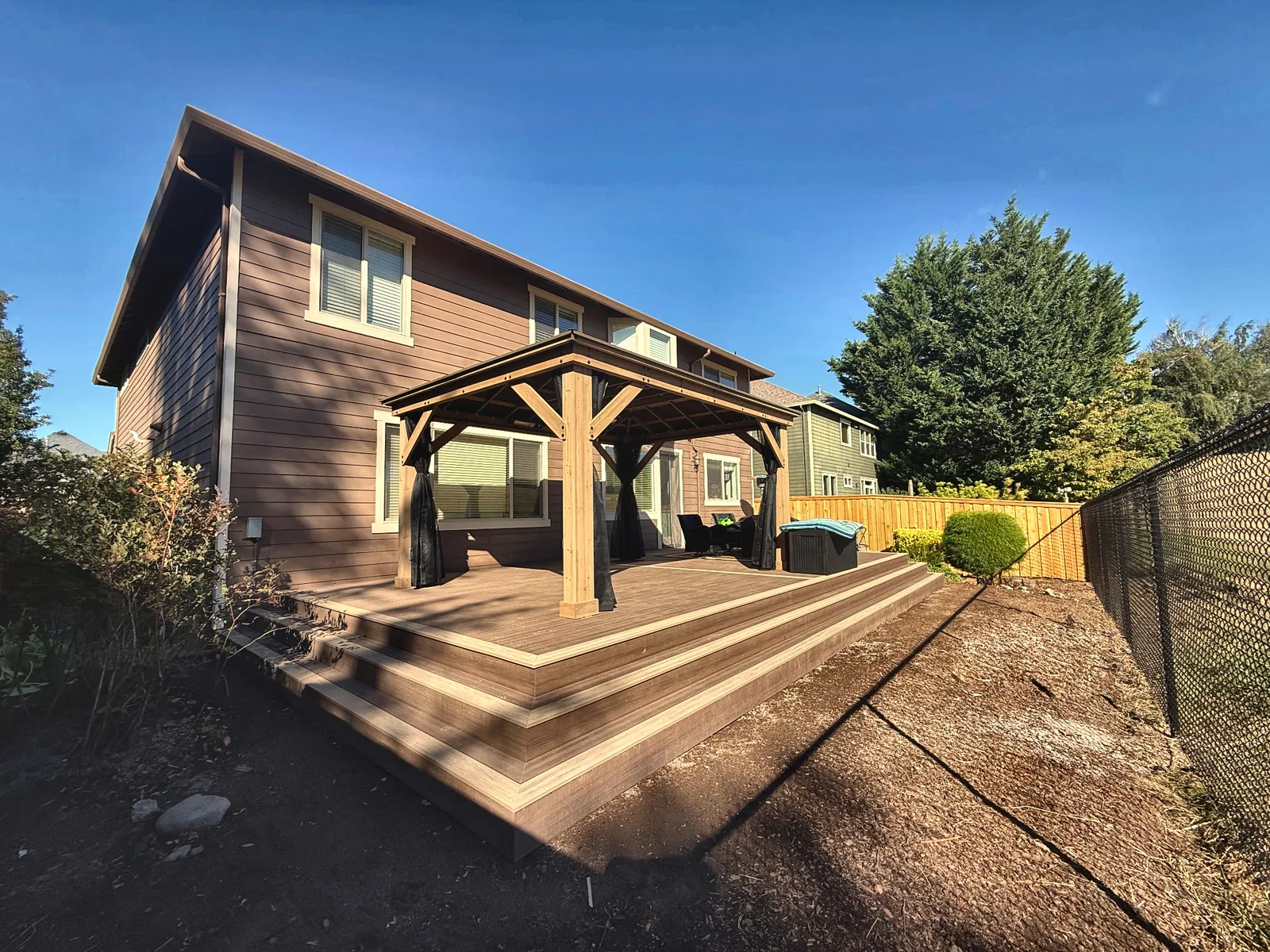
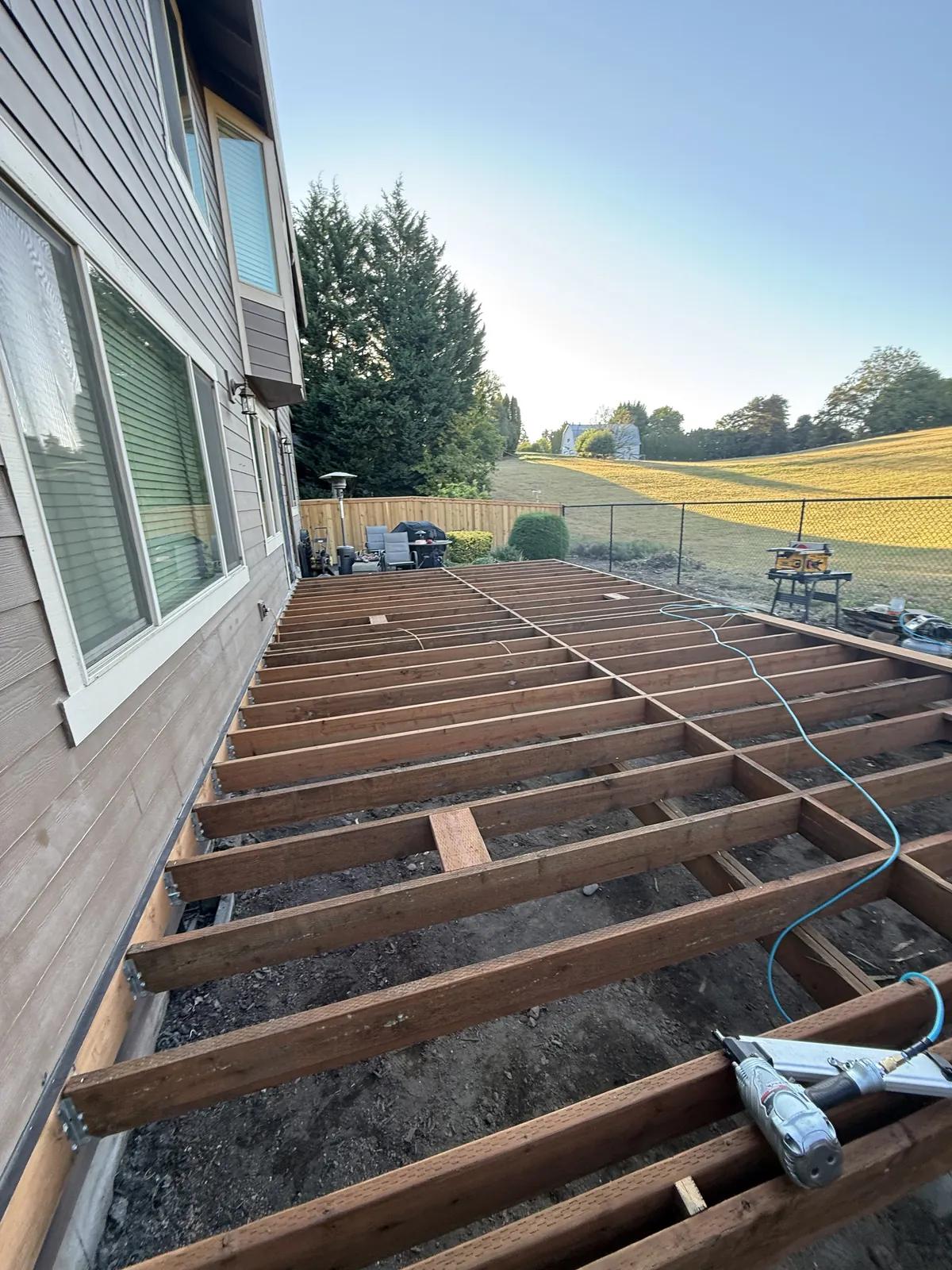 Before After
Most of the decks we are called out to inspect went wrong in one spot, the ledger, the single board bolted to the house wall that passes the whole load back into the framing. Run the flashing the wrong way and water creeps in behind it, and on a north wall kept shaded and wet for months here, it soaks the band joist and the bottom plate with nothing visible from the yard. Little by little the deck eases away from the house while the framing behind the siding goes dark and punky. That board comes off first on any rebuild, and on new work we give its flashing and fasteners all the time they want, since it is the one connection that gives out where you will never think to check.
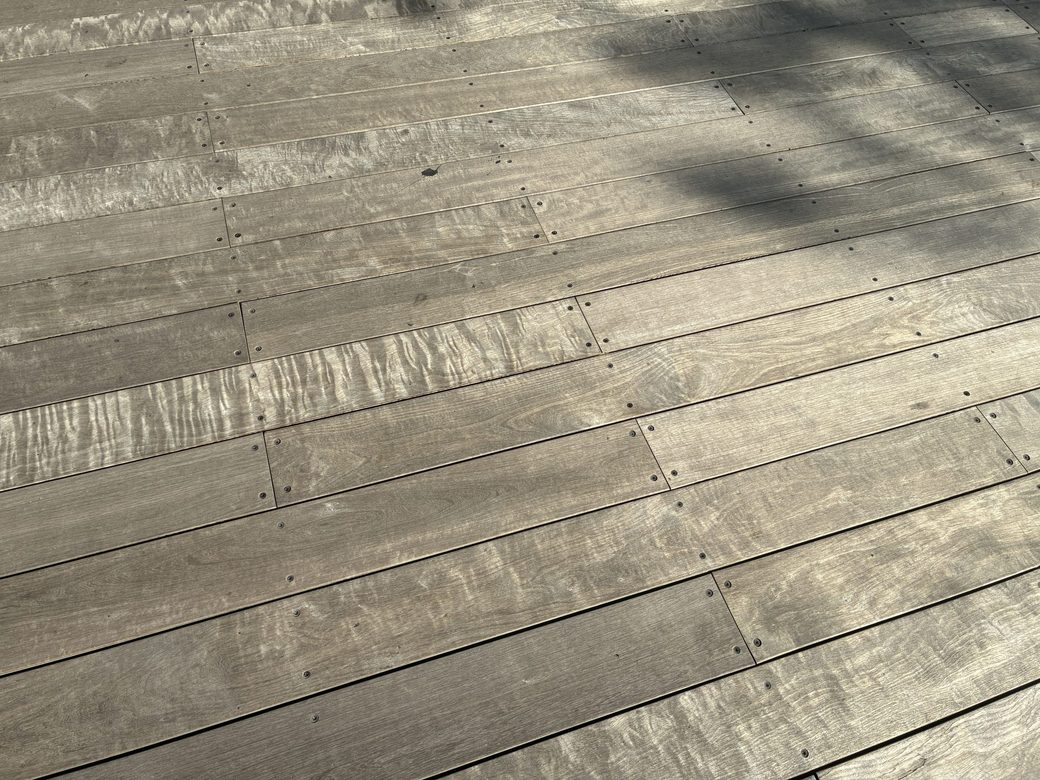
Here is where the choosing happens. There are four calls to make, and only one of them touches the boards underfoot.
The surface comes first, since it is the only layer you actually touch. Treated fir sits at the bottom of the price list and never stops shifting; a full season has to pass before it is dry enough to hold a finish, and from then on it wants steady cleaning and a fresh coat. Cedar keeps its shape better and feels nicer to walk, for a higher price, but so much of today’s stock is soft sapwood that its care routine ends up about even with fir. Capped composite asks for the most at purchase and almost nothing afterward, no fading to gray, no splinters, no sealer, though a south-facing run of it will get warm come July. Where the ground stays wet most of the year, nobody should be comparing cost by the board. The question that matters is plain: will you truly keep up a wood deck with a hose and a can of sealer, and by now most people know which sort they are.
No matter the decking, what is underneath is wood, and that structure is what separates a deck that lasts from one that does not. Ours is framed in treated lumber, with the joists dropped into steel hangers instead of nailed on their ends, and every fastener and hanger specified as hot-dipped galvanized or stainless. Treated wood is loaded with copper, and copper chews ordinary zinc down to nothing, so a bargain hanger corrodes away while it is meant to be carrying the deck. One more small thing earns its place: a band of flashing tape capping each joist, pennies really, sealing off the single edge of the frame that stays damp right through the wet stretch.
Then the footings, out of sight below grade and the part that quietly decides everything. Whatever a deck stands on is the limit of how good it can be. We dig down to the depth Clark County specifies, fill with real concrete, and perch each post on a standoff base so it rides above the pad rather than settling into standing water. That last detail matters most on the low, wet lots down by the creek, where a post sunk straight into the dirt is the leading cause of a perfectly good-looking deck coming out ahead of its time.
Railing tends to track whatever you are looking at, and in these parts that is usually a greenbelt behind the house, a glimpse of the creek, or a territorial view off through the evergreens. The budget route is wood, which asks for the same attention as a wood floor. Most owners end up on powder-coated aluminum in black: narrow uprights, no maintenance, and it reads as almost invisible against a wall of trees. Opening the view all the way takes cable or glass, the priciest choices, which is why you mostly see them on lots that have a view to sell, the bluff homes over in Felida chief among them. Each one comes with its own requirements for how tightly the posts sit and how the infill is handled, and a deck framed for a plain wood rail may not line up with them. None of it bends the code, though. How tall the rail stands and how wide the balusters may gap are written down, not chosen.
Two decisions are far less expensive handled now rather than bolted on down the line. Stairs swallow more money than their small footprint suggests, because every single tread is a little piece of framing in itself, and a wide, shallow set of them costs more than a steep, narrow one, yet that is the line between a deck people spend time on and one they merely glance at. The other is anything electrical, low-voltage lights run below the railing, an exterior outlet, a fan if a cover is going up; wiring it is inexpensive while the frame is still open to the air and a real chore to fish in once the boards are down.
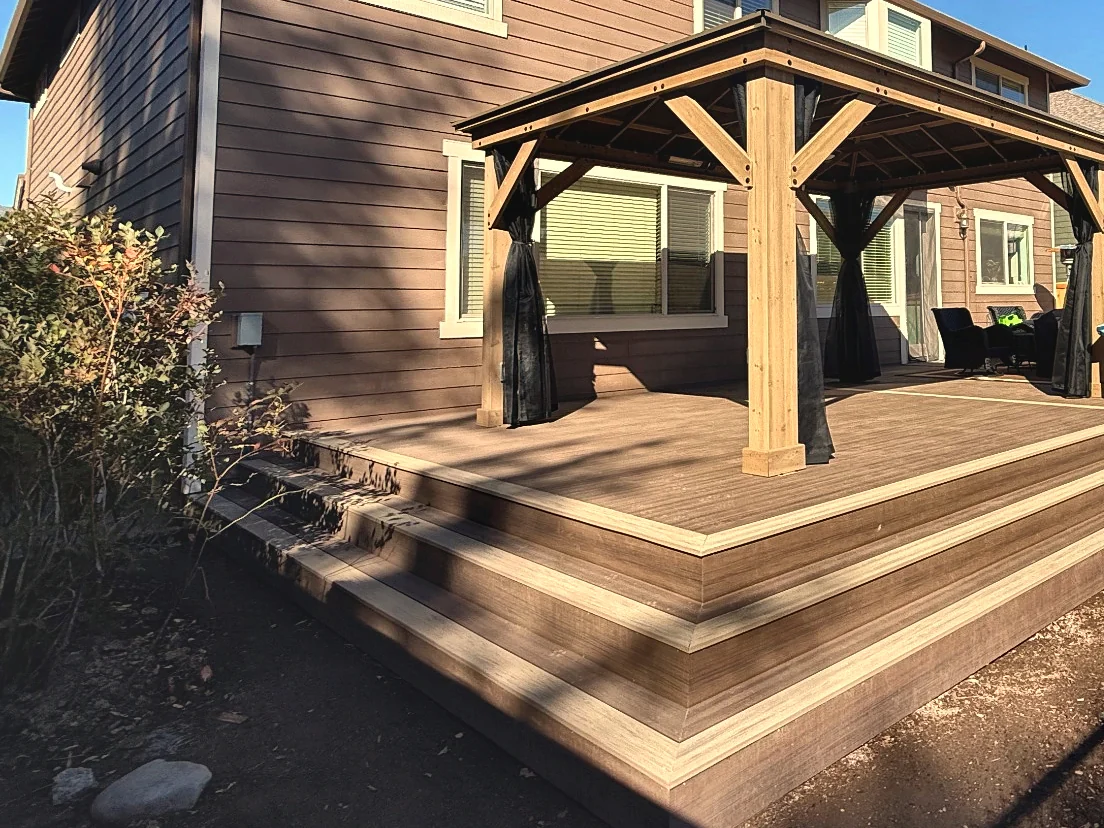
That deck in the photo is one of ours, and it lands both halves of this page in a single shot: a raised deck, with a roofed section that still works once the wet sets in.
Follow the outside edge. A lighter board runs the full way around the deck and carries on around both of the wide steps down to the raw ground. That is a picture frame border. It costs more than cutting the field boards off square, because each one has to be sized to die cleanly into it and the framing under that rim has to be doubled to carry the load. It also does real work, keeping the deck from reading as nothing more than a run of planks. Notice the steps are broad and low rather than narrow and steep, which is what ties a deck down into the yard instead of leaving it stranded on a platform.
The four-post structure standing on it is a wood gazebo with dark mesh curtains at its posts, and its full weight bears right on the deck rather than on footings of its own. So the framing beneath had to be sized for that load before the first board was fastened. This is the plain, visible proof of why a cover counts as framing and not an accessory: what holds it up gets settled in the joists below, long before there is any talk of a roof.
Neither is the wrong pick; they simply fit different owners. Cedar and treated wood run cheaper at the start and can be refinished for years on end, but here they only stay decent if you keep after the washing and sealing on a routine you will actually hold to. Composite is the heavier bill on day one and then asks nothing of you, brushing off the moss and the gray that a shaded, soggy winter forces onto bare wood. Either way, what you walk on counts for less than what holds it up. The frame is wood whichever surface you choose, and it is the quality of that build, more than the boards, that decides how many seasons the deck lasts.
Our rain falls in exactly the months you would otherwise be out in the yard, and that is most of the year. A solid roof flips that. Flash it into the house wall, carry it on posts set over real footings, and the patio becomes space you will reach for in nearly any month, even with the needles coming down. Because it fastens to the structure of the house, it is framing, not a tacked-on shade, so it almost always needs a permit. Out here that goes through the Clark County permit center, since Salmon Creek is unincorporated and has no city hall of its own. The same crew handles the drawing, the county paperwork, and the build.
Three things drive most of the number: the size, how high off the ground it stands, and the surface you choose. The low end is a re-deck at grade over a frame still worth keeping. Fresh footings, tall posts, a full stair run, or a frame that has to be torn out all push the other way. Composite adds to the material cost and buys you out of the yearly upkeep. And if another contractor has already put a figure on paper, bring it to us, because we match or beat most written estimates by 10%, in writing.
The surface boards are not really where your money goes, though they are the first thing everyone prices. The fattest slice is the framing labor: laying out and hanging joists, raising and bracing the posts and beams, and cutting the stairs, which pack more work into a square foot than anything else on a deck. Then come the footings and all the digging they take, and that bill grows quickly the higher the deck rides, because taller posts demand bigger footings and real bracing under them. The decking and hardware follow, and after them the railing, which almost everyone underestimates because it is sold by the running foot and a deck has a lot of running feet. Last is the finish: the skirting, a light or two, a gate, the trim that hides the framing away.
It is why two decks that measure identical on paper can come in miles apart on cost. One might stand several feet up a sloping lot out toward Felida with a long flight of stairs, while the other sits flat on a level yard in one of the subdivisions. With the budget locked, the easiest savings almost always come from dropping the height or simplifying the shape, not from the surface you stand on.
10%
A few quick pictures of where it will go, plus a line or two on what you are picturing, is all we need to start. Get it to us ahead of 5pm and we reply the same day.
There is almost nothing indoors about this job, which makes a deck one of the simplest things to have in progress while daily life keeps going inside. Below is the usual order of it.
We start by pinning down the sizes and heights, where the steps land and how the railing sits, and then the plans head to the Clark County permit center for review. A deck bolted to the house or any cover with a roof has to go through this, and it is the single part of the timeline we cannot push, because it waits on the county, not on us.
We lay out and snap our lines, then drill the footing holes to the depth Clark County asks for, drop in real concrete and set the post bases on top. A spell of rain may cost us this day, because concrete will only cure when the weather cooperates.
Now the back wall gets its ledger, through-bolted and flashed so no water can sneak behind it, then the posts and beams go vertical and are braced off true. Joists fill in next, each one taped along the top. A county inspector has to see all of this while it is bare and reachable, and building in this order is exactly what lets that happen.
The surface boards get fastened down one at a time, a trim board closes off the perimeter, and the stair run is cut and dropped in to finish. Right about here the job stops looking like a stack of lumber and starts to feel like a finished deck.
The rail goes on at the very end, its posts, the top cap and whatever fills the bays, followed by the extras: skirting, a little lighting, a gate where it makes sense. Nothing here is heavy lifting, but it is the difference between a deck that looks finished and one that only looks close.
Everything leaves with the crew at the end, the cut ends, the earth pulled from the footing holes, the dumpster, the lot. Then you and I go over the whole deck with the estimate beside us, and if you landed on wood, I will tell you plainly how long to wait before that first sealer coat.
Sometimes, and when the frame can stay it saves you a real chunk of money. Before anything is promised, we get underneath and work through every part, the footings and posts, the beams, the joists, and the ledger bolted to the house, looking for soft wood and for movement. After that you hear it plainly: keep the frame as is, swap out the bad sections, or it is spent and we rebuild. You choose from what the crawl actually shows, not from optimism.
Nearly always, yes. Once a deck is attached to the house, or rises more than one low step above grade, it needs a permit, and put a roof over it and that is almost guaranteed, because now there are genuine loads to answer for. The twist here is that Salmon Creek is unincorporated, so none of this goes through a city; it all lands at the Clark County permit center. We handle that paperwork as a registered Washington contractor, WA Lic. #EVERGRS757MC, filing the plans and scheduling the framing and final checks. The one exception is a platform sitting right on the grade, fastened to nothing, which can sometimes be left unpermitted.
Count on anywhere from a handful of days to about two weeks on site, set by how big it is, the number of footings, and what the weather is doing. Your estimate spells out the schedule up front, so nothing is left to guesswork. A cover brings a small bonus too: with its roof on, the crew can carry on underneath even when it is too wet to set concrete in the open.
A springy deck is a signal: the frame is either too small for the span or it has begun to soften with rot, and that is worth a visit in person, all the more when the deck sits well off the ground. Before we make the trip, you can help by getting under it safely and photographing the joists and the hangers up close. Send those pictures and we will walk you through what we spot in them ahead of any site visit.
The real answer sits in the frame, not the surface you walk on. Get the frame right, treated lumber, a properly flashed ledger, tape capping the joists, corrosion-proof hangers, and every post held up off its footing, and it will outlive two or three different tops bolted to it over the years. Wood that you actually clean and reseal on time lasts a good long while; ignore it in our damp shade and it goes green, then gray, then spongy. Composite beats either option and still sits on that identical frame, which is the whole reason we push every one of these conversations back down to the framing.
Frequently we can. If the slab leaves enough vertical room and it still throws rainwater clear of the house, we build a low deck on sleepers resting on the concrete, no excavation and no poured piers needed. Where it falls apart is a slab that has heaved and cracked or tilted to pool water at the wall. We fix that condition up front, since locking damp against your foundation under new boards is the kind of hidden, pricey problem that stays invisible right up until it is serious.
Yes, and combining them into a single build is where the savings are. A roof over the deck rests on one of two things, the deck’s framing or a set of dedicated posts and footings, and either path means that weight has to be accounted for in the plan from the start, not once the boards are on. Adding the cover down the road usually forces us to lift decking we already laid just to get back to the frame, so you end up buying the same labor twice.
In this climate a flat deck surface is going to grow moss; there is no dodging it, and the firs and cedars overhead make matters worse by shedding needles that jam the gaps and keep moisture pinned to the boards. Your defense is a clear channel between the boards, tape run over the joists beneath, and a solid wash once the worst of winter lifts; that holds back most of it. Still, a deck buried in year-round tree shade that never gets a real dose of sun is not asking to be sealed more; it is asking to be composite in the first place.
Our shop is on SE 184th Avenue in east Vancouver, a quick run over to Salmon Creek by I-205 and I-5 with no bridge to cross, so this deck work stays close to home. We build right across the Salmon Creek subdivisions, those curving 1980s to 2000s streets where the decks are now aging out, out onto the bigger custom and view lots in Felida, through Mount Vista, Pleasant Valley, Sherwood and Lake Shore, down toward Hazel Dell, and on the greenbelt and territorial lots backing the creek, the greenway and the trees near Klineline Pond and Salmon Creek Regional Park, along with the rest of southwest Clark County.
Three of the 50 reviews on our Google profile, in the homeowners' own words.
Wow. Just Wow. Had the Evergreen crew replace existing fencing, put in a 33.5ft x 18.5ft multi-tiered deck, and assemble a 12ft x 16ft gazebo. Couldn't be happier with the results.
Anthony L.Deck, fence and gazebo
We talked to 4 different contractors and only David, of Evergreen, took the time to climb up to our roof to check out the job. The others gave us bids based upon a photo. Evergreen was not the cheapest but the extent of the work they did was worth every penny.
Steve K.Roof and exterior work
We had a small but very unique project and this team handled it with a great attitude. They were responsive, on time, and the finished work looks like it was always meant to be there.
Paige T.Small custom project
Send photos and a short description. If it arrives before 5pm you get an answer the same day.
Already have a written estimate from someone else? Send that too. We match or beat most estimates by 10%.
Built for the wet side of the river.

Licensed and insured remodeling contractor serving Vancouver, WA and the Portland metro.
Oregon CCB #262707 · WA Lic. #EVERGRS757MCEvergreen Renewal Services LLC
505 SE 184th Ave Unit 320
Vancouver, WA 98683
© 2026 Evergreen Remodeling. Oregon CCB #262707 · WA Lic. #EVERGRS757MC. Evergreen Renewal Services LLC. All rights reserved.
Same day response on anything sent before 5pm.