

General Remodeling in Camas, WA
No two Camas houses hand you the same remodel. A craftsman near Crown Park hides lath, plaster and knob and tube behind its walls; a newer place in Camas Meadows wants rooms opened up and rewired for how people live now. Plenty of jobs will not sit in one trade’s lane, a main floor needing framing, wiring, plumbing and finish carpentry at once, and those want one owner-led crew. We work one way: open it up, find what is really wrong, fix that, then make it look like we were never here.
Licensed and insured. WA Lic. #EVERGRS757MC
On anything sent before 5pm
We match or beat most written estimates
Remodels completed
What general remodeling covers
More than one room at a time
A basement turned into living space, a tired main floor refreshed, the whole house in one pass.
When a fix becomes the remodel
We chase down what caused it, put that right, then build the room back better than it started.
Before the house goes on the market
Your agent’s repair list, cleared by one crew on one schedule before the photos.
Finish trades, one crew
The finish trades are what everyone notices, and they decide whether a remodel reads as a single job or a string of repairs. Our crew tapes and textures the walls, hangs doors, runs trim, lays flooring and paints, so the sequence stays tight and the seams between rooms line up.
The middle ground a handyman cannot reach
A handyman is the right call for a sticking door, a loose towel bar or a single fixture swap. Once a job needs a permit, touches framing, relocates pipes or wiring, or asks several trades to share a calendar, it belongs with a licensed remodeling crew, and that middle ground is where we work.
The same corner, before and after
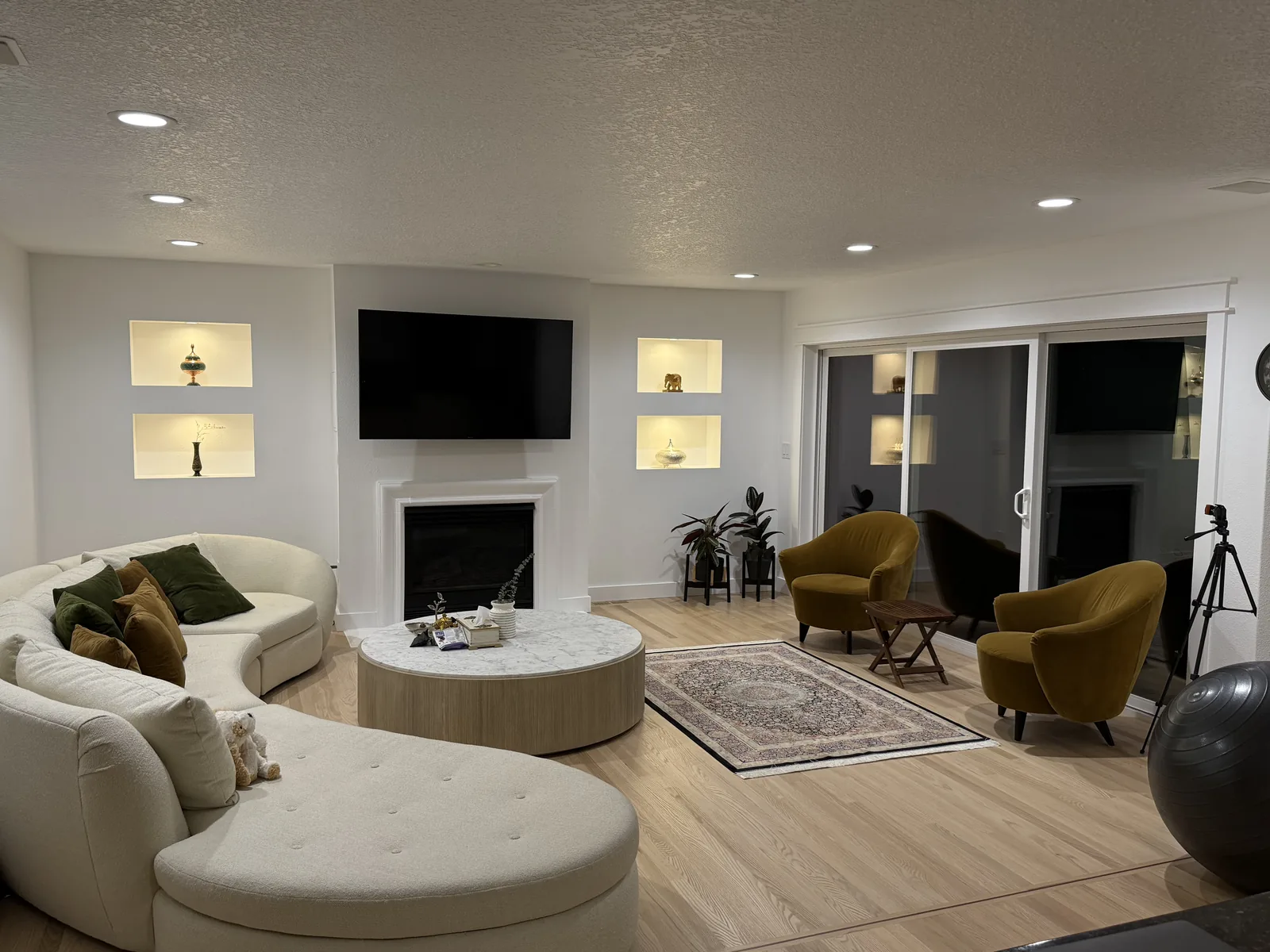
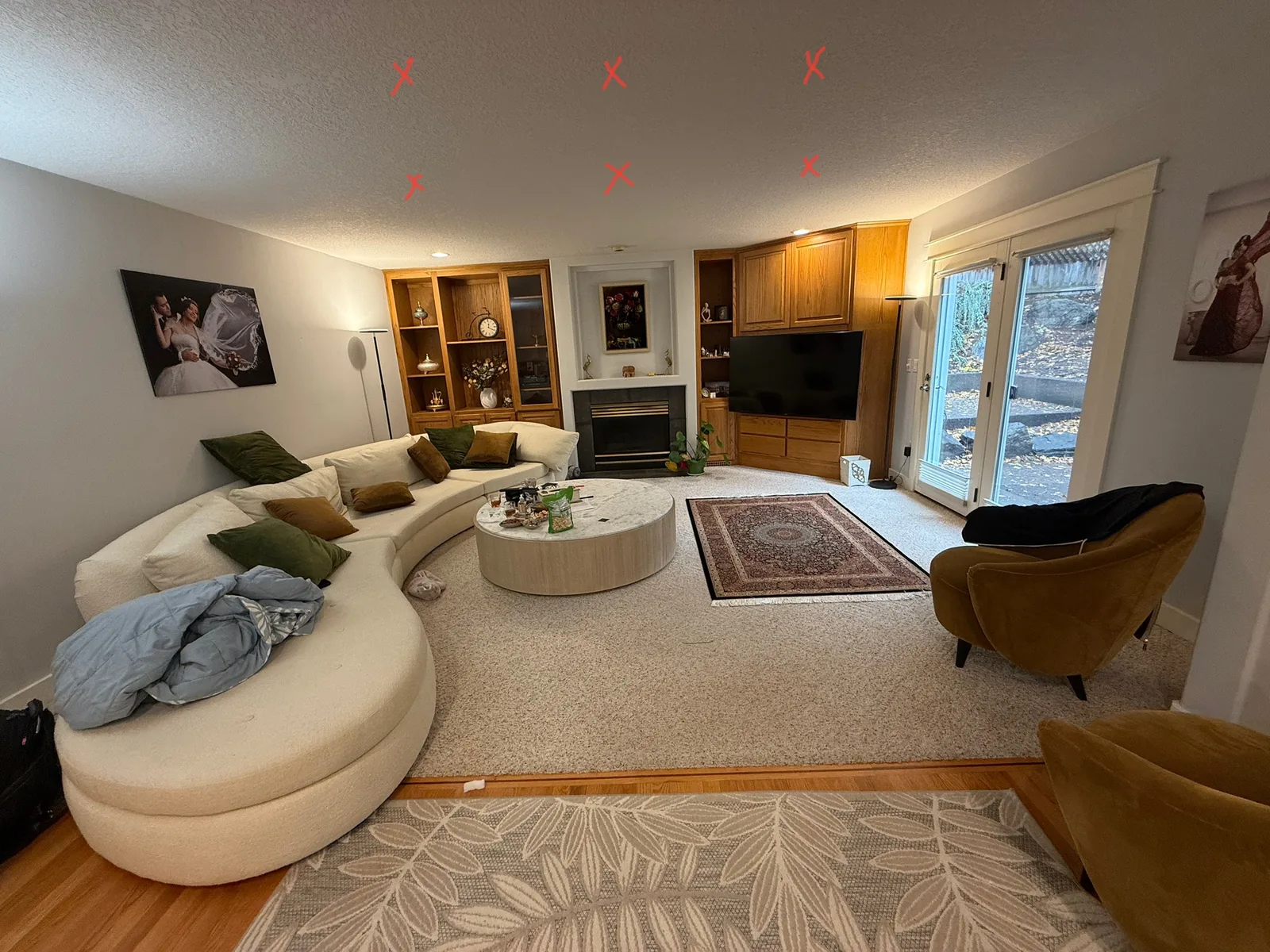
A living room is mostly built-ins, ceiling and light. This is the same corner before the crew started and after they left.
Drag the handle. Left, the room as it was: oak built-ins either side of the fireplace, a textured ceiling, and the marks on it where the new lights would go. Right, the same room finished: the built-ins rebuilt in white with lit niches, and the ceiling done.
 Before After
Where owner-run earns its keep
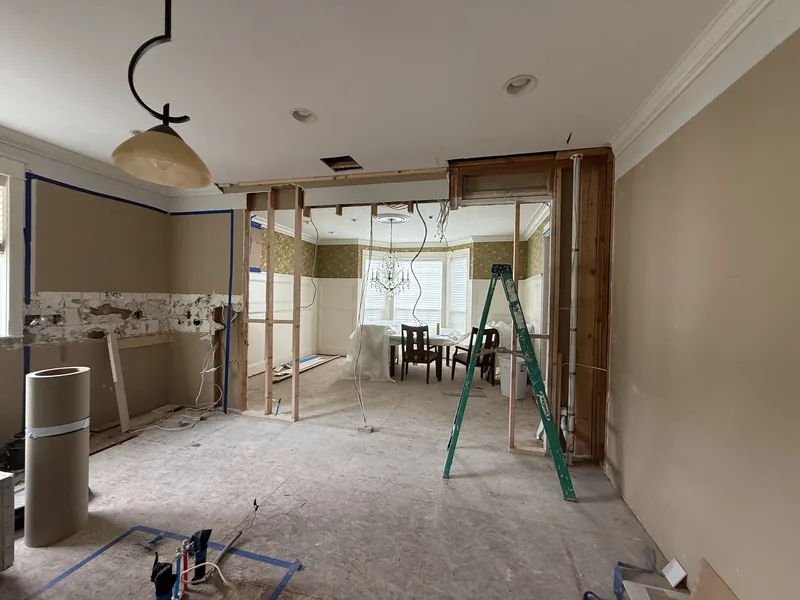
Multi-trade remodels rarely fall apart on the work itself. They fall apart in the gaps between trades, the flooring crew showing up before the plumber has signed off, a cabinet order nobody confirmed, two subs each sure the other one booked the inspection. Those gaps only close when one person holds the whole schedule and that person has actually stood in the house. On a Camas job that person is David. He prices it, he runs it, and the number you call on the first day is the number you call on the last.
Five calls almost every remodel forces
The rooms shift and the budgets too, but a familiar handful of questions surfaces on nearly every Camas walk. Here is how we think them through with you.
Flooring usually comes up first because it touches every other trade. In a climate that stays damp from October into spring, luxury vinyl plank earns its place: water runs off it, it is quiet, and a ruined plank pops out without redoing the whole floor, though up close it will never read as real wood. Engineered wood is a thin layer of actual hardwood over a stable core, so it rides out the wet-season swings that leave solid boards cupping, and you can sand it back once, maybe twice. Solid hardwood is the floor your grandkids inherit and also the one that lifts the week a fridge line lets go. Tile wins on wear and loses on warmth underfoot. What we are really asking is how the house gets lived in: big dogs, young kids, a concrete slab downstairs, or a quiet couple.
Wall finish is the decision nobody walks in expecting to make. Pull a cover plate in an older downtown home and you often find plaster over wood lath rather than drywall, and tying new work into that cleanly takes a skim coat or a plasterer with real patience. On fresh drywall the thing worth paying up for is the finish level. A level four is the normal spec and it still telegraphs every seam when morning light rakes across the wall; a level five skim coat costs more and pays for itself on any long wall facing a window. Sheen plays the same trick: flat swallows the flaws, satin takes a wipe cloth, and on a wall lit from the side flat is quietly covering for you.
Doors and trim age a house faster than any paint color. A hollow-core door is cheap and says so every time it shuts; a solid core costs more and makes a room feel done the moment the latch clicks. With trim, the move is to match whatever the house already runs, and when there is nothing worth saving, settle on one profile and carry it through every room. A hallway running three different casings is a dead giveaway that three owners each took a turn and none of them talked to the next.
Any time a wall or ceiling is already open, two things are cheap that will cost a fortune later. Insulation is the first, and it matters most on the walls against an unheated garage or that one room that never holds heat through a Camas winter. Wiring is the second, a spare circuit, a dead run stubbed in for a bath fan you might add, a line to wherever the television is landing, an outlet to retire the extension cord stretched across the floor. Done while the cavity is open, both cost a sliver of what they run once someone has to cut the wall back apart.
Last is the order the list gets done in, and it matters more than most people think. Anything tied to water, structure or the roof goes to the front, no exceptions, because everything after it is finish work and finish work is exactly what gets wrecked when something upstream lets go. After that come the trades that throw dust, then the ones that make a mess, then paint brings up the rear. The identical scope costs less run in that order than run in whatever order the rooms happened to bug you, and setting that order down on paper is most of what you are paying a general contractor to do.
A kitchen with the work still showing
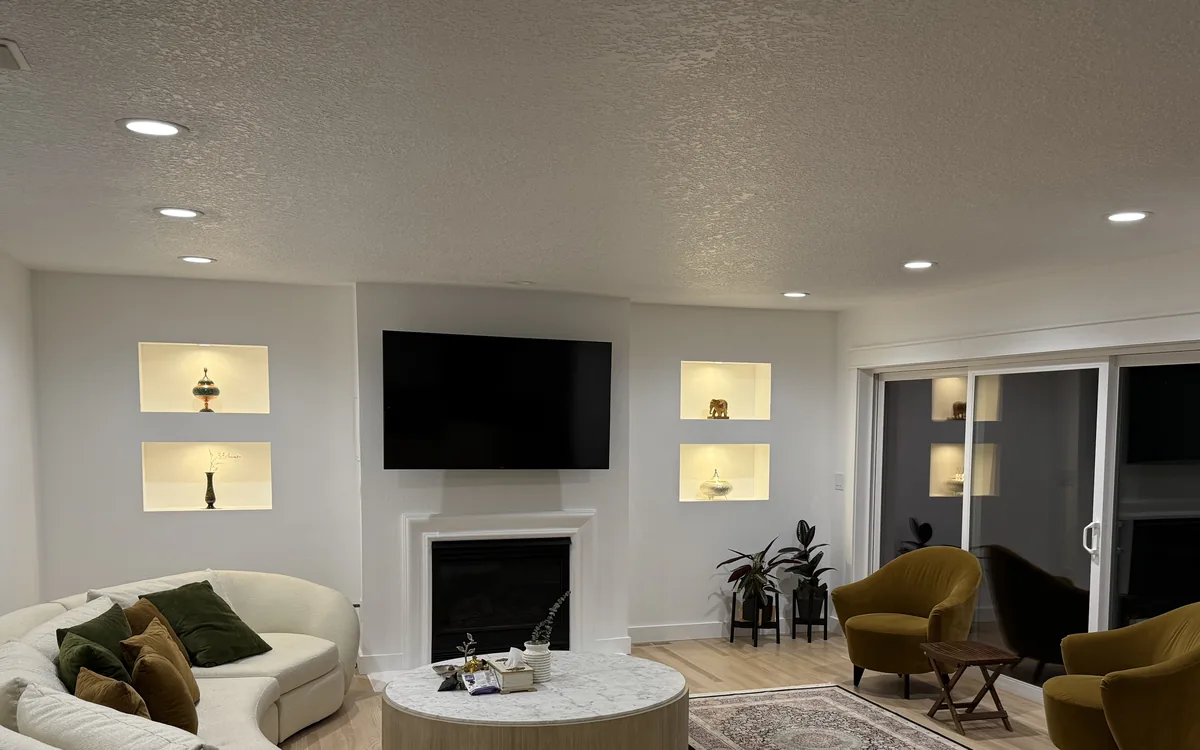
This is the finished side of the living room in the before and after above, a real job of ours. The oak built-ins on either side of the fireplace are now white, the display niches are lit, and new lighting sits where the before photo only shows marks on the ceiling.
It is also a fair picture of what general remodeling actually involves. It is one room, but carpentry, electrical, drywall and paint all had to land in the right order, and each trade had to leave the next one a clean start. Run a project room by room instead of hauling in every trade at once, and a result like this is simply a normal stretch of work.
This is also where a list turns into a real schedule. Walking the room with the homeowner before anything comes apart, you can tell what is solid, what has to be touched and what is fine left alone, and on a job this size a fair chunk of the savings comes straight out of agreeing what stays untouched.
Cause first, finish second
More remodels than you would guess open as one job and turn into another. Pull the vanity in an older Grass Valley bath and the subfloor is spongy from a slow supply line; lift the carpet in a downtown house and find a joist that has been quietly feeding moss for years. Rot and structural repair are the work we are known for, so a find like that does not freeze the job or drag in a second contractor. We price it as its own line, you say yes or no, and the schedule keeps rolling. The finish you came for ends up resting on a repair done right, which is the only version that holds up.
What a Camas remodel runs
General work is priced off the scope, so the estimate comes back split room by room and trade by trade, one figure for the drywall, one for the floors, one for the wiring, each on its own line. Broken out that way it is simple to pare back, since you can see to the dollar what drops off when an item goes. It also keeps a competing bid honest, so if you are holding another contractor’s written quote for the same work, we match or beat most estimates by 10%, in writing.
Where the dollars land comes down entirely to what made the list, which is the whole reason we itemize rather than quote one lump sum. As a rule, the hours are the bigger half of almost every line, and the finishing crews run more time than people expect: taping, casing, hanging doors and painting are mostly labor with little stock behind them. Floors flip that, where the product leads. And opening a wall or a floor sits in its own bucket, priced as the hours plus whatever the house turns out to be hiding.
Sequence swings the number as hard as it swings the calendar. Set cabinets before the walls are floated and taped and half of them come off again. Drop flooring before the dusty trades are done and you spend the job covering it or replacing it. The same list, run in the right order, comes in cheaper than that list run in the order the rooms happened to nag you, and pinning that order down is a big part of what a general contractor is actually for.
10%
Have a written quote? Send it over
Send it over exactly as you got it. A rough scan is plenty. If it arrives before 5pm, you hear back the same day.
Walking a multi-room job start to finish
Most of these happen while you are still living in the house, so every step is built to keep the place livable. Here is how it tends to run.
The first walk-through
We walk the full property beside you with your list in hand, flag anything we spot that is not on it yet, and sort the must-do items from the nice-to-have ones. Each group gets its own price, so you stay the one deciding what makes the cut.
Lining up the trades
Anything with a wait on it goes on order up front, doors, flooring, tile, fixtures, anything built to a measurement. Then the trades get stacked into a sequence, and that sequence is the plan: water and structure lead off, the dusty work follows, and paint comes in at the very end.
Sealing off and setting up
We lay floor protection, hang dust barriers wherever a room is active, set a route in and out that skips your main living space, and settle the working hours. If you are staying through it, we agree on one room that stays entirely yours.
The loud, rough stage
Framing, plumbing, electrical and anything that carries load, with permits and inspections run through the City of Camas Building Division on NE 4th Avenue or its online portal where the code requires it. This is the loud, dusty stretch, and we push through it in one pass instead of three return trips.
Finishes, room by room
Taping and mudding, casing and base, hung doors, flooring and tile, all one room at a time. The house comes back to you in finished pieces as we go, not a job site standing until the last day.
Paint and the final walk
Paint is the last thing to go on. Then we walk the finished job together and write the punch list side by side, because we would much rather you flag something while we are here than notice it a month after we leave.
What homeowners ask about remodeling
How long will a whole-floor remodel tie up my house?
Honestly, it depends on the list and on what we are waiting for. The big drivers are lead times on anything built to a measurement, whether the City of Camas has to inspect a stage before the next one can start, and how much turns up once the walls are open in an older home. You get a realistic window at the quote, not a number built to win the job, and if it moves we tell you the day it moves and why.
Does my Camas remodel need a permit?
In many cases, yes. Moving plumbing or gas, changing the wiring, taking out a wall that carries load, or anything structural goes through the City of Camas Building Division on NE 4th Avenue or its online portal, not the county. We pull the permits and meet the inspector, so you are not left chasing paperwork. Wider openings and longer spans sometimes need engineered, stamped plans, and we tell you up front if yours is one of them.
You opened a wall and found trouble. What happens to my budget?
Older Camas houses almost always have a surprise or two waiting, knob and tube that was never fully swapped out, a supply line worn thin, a stud with old rot in it. When we hit one, we do not stop the job and reopen the whole price. We quote just that piece as its own line, show it to you, and you decide, while the rest of the schedule keeps moving.
Can you make new work blend into an old house?
That is most of the craft in remodeling an older home. Near downtown and Crown Park we are usually tying into plaster over lath and trim profiles they stopped milling decades ago. We match the casing and base already on the house rather than whatever the lumberyard stocks, feather new plaster into the old, and aim for a result where you cannot pick out where our work starts. Fix the cause, then make it look like nothing happened.
Do you run the whole job or am I chasing trades?
You are not coordinating anyone. This is an owner-led crew, so David prices the work, sets the order the trades arrive in, and is the one on site making the calls. When a licensed specialty trade is required, they work to our schedule and our standard, but the responsibility never leaves us. One job, one plan, one person answerable for how it turns out.
Can we keep living here while you work?
Almost always, and most of our jobs run exactly that way. We seal off the rooms in play with zippered dust barriers, protect the path in and out, and sequence the work so you keep a usable kitchen and at least one bathroom the whole time. We also settle the working hours before day one, so the house still feels like yours in the evening.
It rains here most of the year. Does that change the plan?
For interior work, not much. Drywall, flooring and finish carpentry go on through the wet months without trouble. Where the weather matters is anything that opens the outside of the house, swapping a door, cutting in a window, or dealing with siding and the rot behind it. Camas stays damp from about October into June, so we schedule that kind of work for the drier stretch and keep anything we open covered until it is closed back up.
What do you need from me to put a number together?
A few photos and a short description of what you want done is enough to start, and a rough list beats a polished one. Anything that reaches us before 5pm gets an answer the same day. If you already have a written estimate from another contractor for the same work, send that along too, because we match or beat most estimates by 10%.
Where we work around Camas
Our shop sits at 505 SE 184th Ave in east Vancouver, a quick run west of Camas with no bridge to cross. We take remodels all over town, the early-1900s homes around downtown and Crown Park, the view lots on Prune Hill, the established streets of Grass Valley, the lower ground near Lacamas Lake and the newer builds in Camas Meadows and Fern Prairie, plus Washougal and the rest of east Clark County.
The rest of what we do
What homeowners say
Three of the 50 reviews on our Google profile, in the homeowners' own words.
We had a small but very unique project and this team handled it with a great attitude. They were responsive, on time, and the finished work looks like it was always meant to be there.
Paige T.Small custom project
David the owner came by for a quote and was able to get us scheduled right away. The communication was great with his team and the guys were on time and very professional. Would highly recommend.
Scott G.Kitchen nook bench
We talked to 4 different contractors and only David, of Evergreen, took the time to climb up to our roof to check out the job. The others gave us bids based upon a photo. Evergreen was not the cheapest but the extent of the work they did was worth every penny.
Steve K.Roof and exterior work
Tell us what needs fixing
Send photos and a short description. If it arrives before 5pm you get an answer the same day.
Already have a written estimate from someone else? Send that too. We match or beat most estimates by 10%.
- Call(971) 715-0673
- Emaildavid@evergreenremodeling.co
- Office505 SE 184th Ave Unit 320, Vancouver, WA 98683
- LicenseWA Lic. #EVERGRS757MC