

What we do most
Wood Rot Repair in Camas, WA
Rot is a water problem before it is a carpentry problem, and Camas hands wood plenty of water: a long wet season, something like 45 to 50 inches of rain a year, and an east wind off the Gorge that throws it flat against the walls that face it. Those exposed walls, up on the Prune Hill hillsides and out along Lacamas Lake, are the ones we get called to most. Repairing it so it stays repaired means tracing the leak back to where it started, cutting the wood past the last soft fiber, and rebuilding whatever carries load before a stick of siding goes back on. It is most of what we do, and it is what we are known for.
Licensed and insured. WA Lic. #EVERGRS757MC
On anything sent before 5pm
We match or beat most written estimates
Remodels completed
The repairs we get called for
Across a Camas winter, water works its way into just about every exterior joint on a house. These are the spots it reaches first, and the ones we open up most:
Siding, corners and trim
The pieces that take the weather first: corner boards gone soft at the foot, the casing around windows and doors, water tables and belly bands, and whatever sheathing is hiding underneath.
Decks and ledgers
Spongy decking and the joists and beams below it, plus the ledger that bolts the whole deck to the house. On a walkout deck hung off a Prune Hill slope, that ledger takes the wind and lets go first.
Framing that carries load
Rim joists, sill plates, studs and post bases that have been drinking moisture up out of damp ground, common on the lower lots near Lacamas Creek and Round Lake.
Window and door flashing
Flashing that let go years back and has been steering every rain into the wall ever since, which the Gorge wind only hurries along.
Subfloors below baths and kitchens
A supply line or a shower pan weeping for months on end, turning the subfloor spongy long before anything shows at the surface.
Cannot tell what it is?
Snap a few photos and tell us what you are looking at. Reach us before 5pm from anywhere in Camas or Washougal and you hear back that day, and if it is not something we should be touching, we will tell you so plainly.
One wall, apart and back together
On rot work this is the only proof that means anything. A finished photo shows a wall. A pair shows what was behind it.
Drag the handle. One bathroom, the shower wall opened to the studs after a leak: framing stained black where the water sat, insulation exposed, the drain open in the subfloor. Then the same space closed up and tiled under the same skylight.
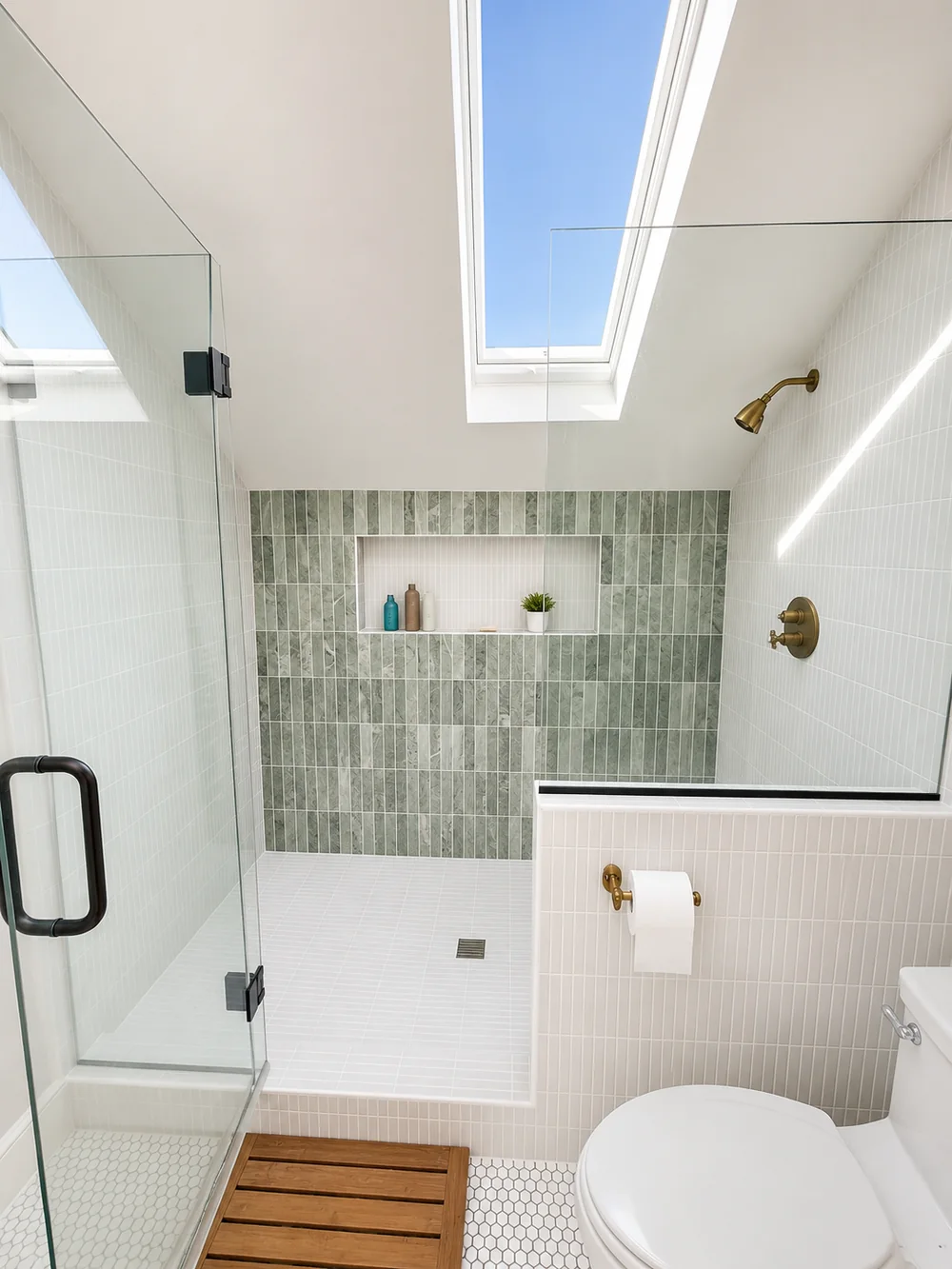
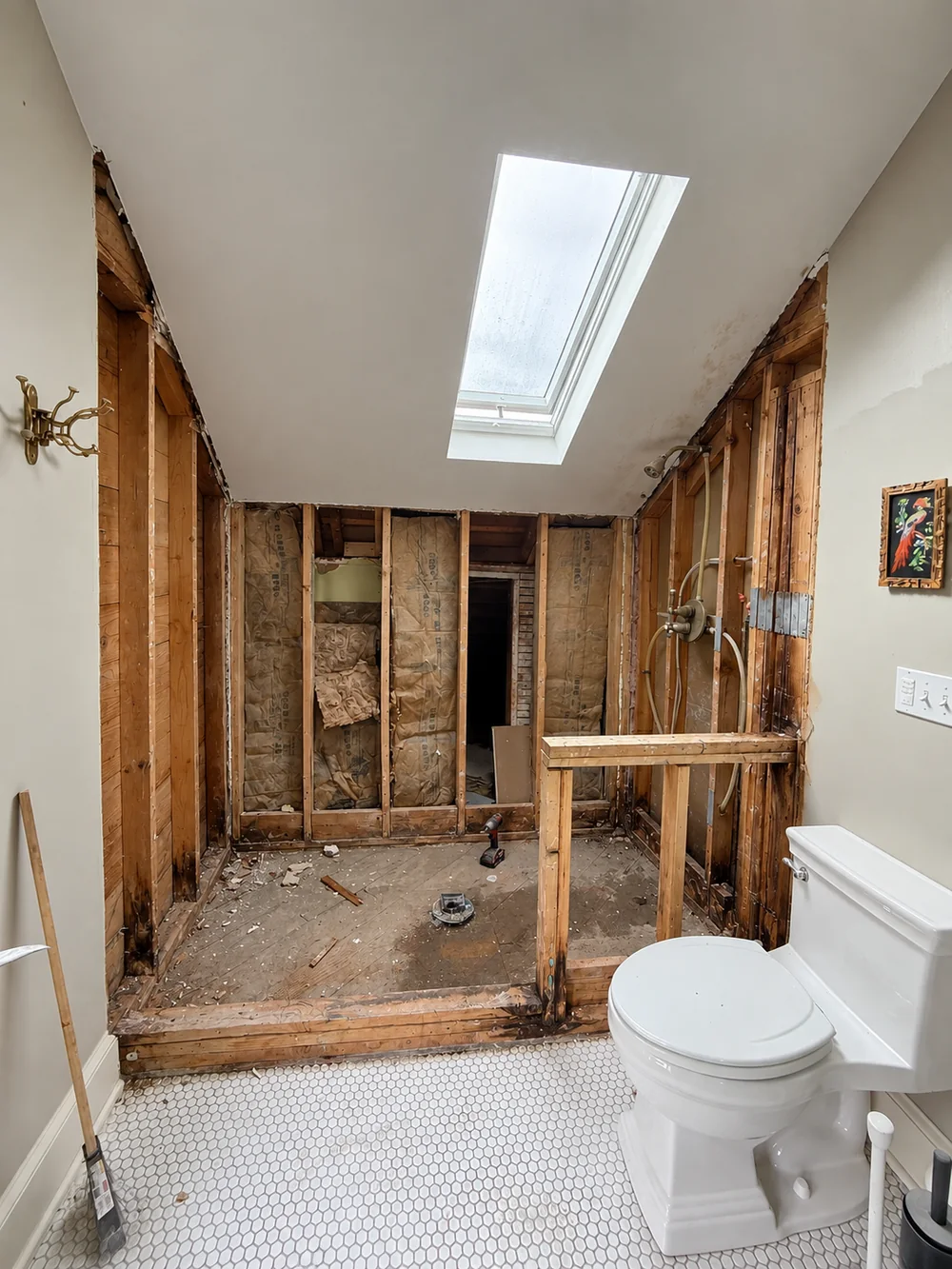 Before After
A photo hides the real job
What shows on the surface is the small end of the problem. Rot moves along the grain under the paint and behind the siding, so the stain or the soft spot you can put a finger on is where the damage ends, not where it began. On a wall that has been catching Gorge wind for years, the gap between those two points can be wide. Put a number on a photo and you are really putting a number on a hope, and that hope turns into a change order the first day the wall is open.
So we come out and get our hands on it. We draw a hard line between what we can confirm standing in front of the wall and what will only show once it is open, and the estimate reads the same way: the certain work priced firm, the possible extent set on its own line that you sign off on before a saw comes out. You are never left guessing which figure is solid, because the paper says so.
What Gorge wind drives into a wall
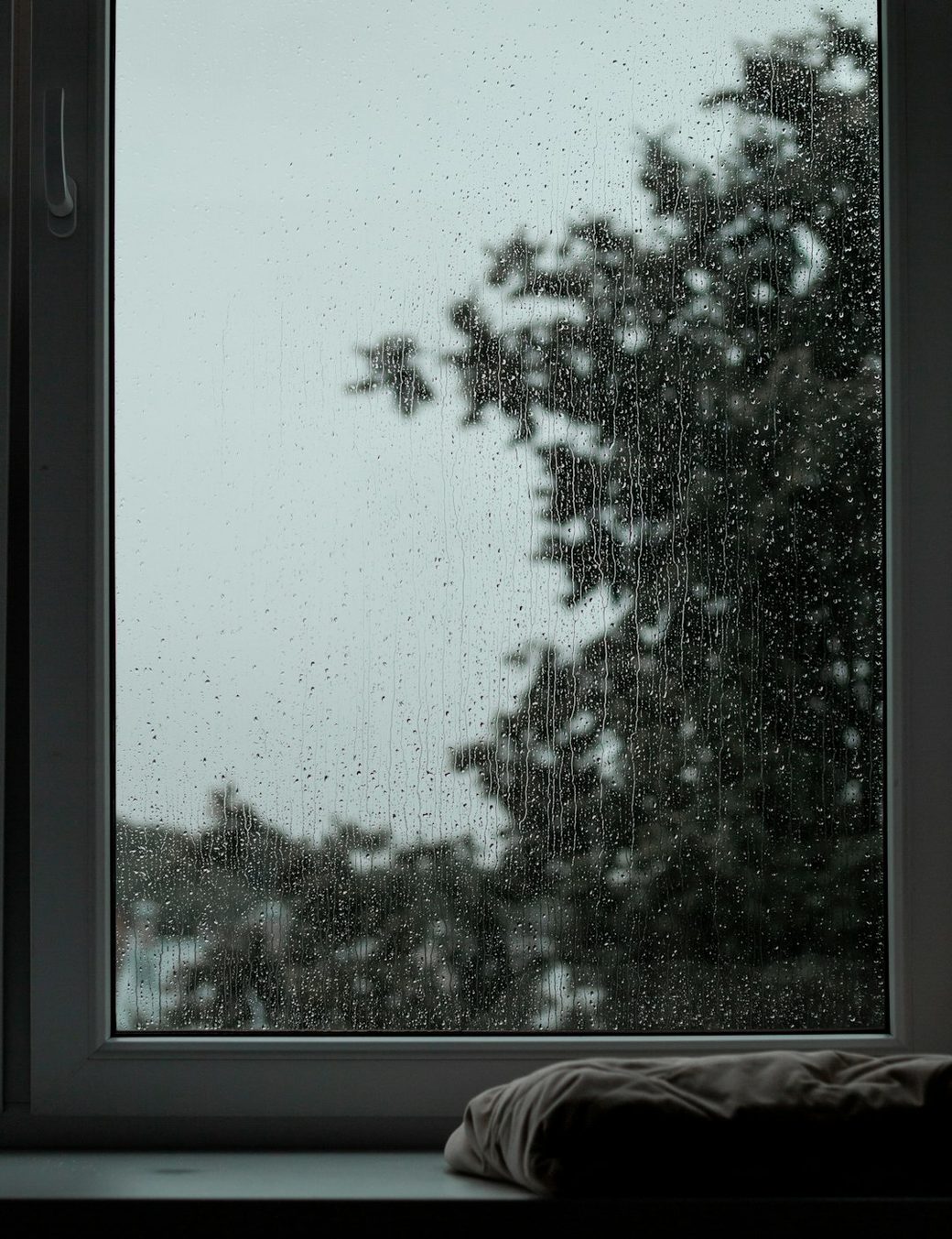
Camas sits close enough to the mouth of the Gorge that wind-driven rain is a regular part of the weather here, and homes on the exposed slopes of Prune Hill catch more of it than most. That wind does not just add rain. It forces water into seams and laps that would stay dry in a calmer spot, which is why windward walls tend to show trouble first.
Picking wood that lasts the second time
Cutting the rot out is half the job. The other half is choosing material that will not fail again at the same corner ten years from now.
We start by matching what is already on the house, because the best rot repair is the one nobody can find afterward. Say an older home near Crown Park still carries its original cedar corner boards; cedar is what we put back, run to the same profile. If that profile left the market long ago, we shape it up out of stock lumber until its reveal and shadow line fall right in with the courses on either hand.
What makes cedar and redwood last is the oil held in the heartwood, although the sapwood in boards sold today is nowhere near as tough as the old growth it replaces. Finger-jointed pine, primed, is the cheap route and it holds paint beautifully, yet it gives way quickly in any spot that stays wet, and here that is most of the calendar, so we keep it clear of the dirt and off the foot of a trim run. PVC and fiber cement simply do not rot. For the places that fail over and over, the base of a corner board, a water table, the casing beneath a window left without head flashing, that is the sensible choice. The price per foot is higher, and it buys you out of a third repair at the same spot.
Framing gets its own judgment. Whatever bears on concrete or rides close to grade comes back as pressure-treated, since untreated fir laid against a wet foundation is how the original sill gave out. Where we sister a joist or stand a new stud, it is Douglas fir, sized and fastened to carry what came before, not just to bridge the opening.
People underrate the fasteners. Copper in current treated stock chews up ordinary galvanized steel, so screws and nails going into treated lumber or cedar come in hot-dipped galvanized or stainless. Drive a plain screw into cedar and within one season black runs bleed down the board, and after that paint hides nothing.
Before a single board is installed it gets primed on all six faces, ends included. Bare end grain wicks water like a straw, and whether that sealing happens or gets skipped tells you more about the lifespan of the repair than the label on the paint can.
Swap the board, or open the wall
The real size of a rot repair comes down to four questions. You can settle the first two on your own, screwdriver in hand, inside a free hour.
Is it holding anything up? Trim, a water table, the lowest course of siding: none of that carries the house, and a bad length is a lost afternoon and little else. A rim joist, a sill plate, a post base or a deck ledger is another matter, because it holds the building up, so that work gets shoring, sound replacement wood, and a permit and inspection through the City of Camas Building Division on NE 4th Avenue. What drives the bill is never the board itself. It is everything that has to happen around pulling it safely.
How far does the soft stretch run? Walk the screwdriver along the piece every few inches until the tip quits sinking in, then carry on a good foot past that last soft spot. Rot travels down the grain well ahead of anything the paint shows, and stopping at the edge of the visible damage is the single most common reason a repair comes back.
Does epoxy belong here? Now and then, and we will tell you when. Consolidant and filler do real work on a shaped piece you cannot buy anymore, a window sash, a porch column, a length of period trim, as long as the rot sits in a pocket and has not gone clear through. They do nothing for structure, and they are no way to dodge opening a wall. Anyone pitching epoxy on a soft sill plate is quietly selling you the same job a second time.
And what sits over the top of it? This is the one that decides whether the fix lasts. The water came in somewhere upstream: a missing kickout where a roofline dies into a wall, a gutter that jumps its edge in a hard Gorge rain, siding packed into a flower bed, a deck ledger with nothing lapped across the top. We track that down and fix it first, priced right beside the wood, because fresh lumber under a leak that is still running is money spent twice.
What a rot repair runs
Honestly, the number rides on how much rot there is, and nobody knows that for certain until the deck or the wall is open. Here is what holds true before that point: a tight, local job, a short run of trim or a few soft deck boards, lands low; once joists, sills or post bases are involved the figure climbs, because shoring and an inspection ride along with structural work; and the factor that moves it most is the count of seasons the leak has been feeding. Where the rain keeps coming for most of the year, the least costly rot repair is always the one handled now instead of a year on.
Knowing where the dollars really go tends to surprise people. Material is the small end of a rot invoice. Labor and reach are the big end: rigging staging or working out a ladder, stripping siding back far enough to get behind the damage, propping a load clear while a post is rebuilt, and then sealing the wall up so no trace is left. A ten-foot run of bad trim under the eaves costs more than twice what the same run costs at standing height, and splitting the work across two far corners of a house costs more than one larger patch in one place.
In rough order, you are paying for labor, then for the weatherproofing that locks the repair in, meaning flashing, house wrap, siding, primer and paint, then for the lumber, and finally for a permit and inspection if the job is structural. Every item that has to be taken down and rehung is called out separately: a downspout, a gutter, a sconce, a run of deck railing, a dish on the eave. It all goes on the sheet itemized, so the share that is wood and the share that is access are plain to see.
Holding another company’s written bid already? Bring it along. On most written estimates we will match the figure or beat it by 10%, and you get that promise in writing.
10%
Got another bid?
Send it across with a couple of photos of the trouble spot. In before 5pm, answered the same day.
Living through the work
Most of a rot repair happens outside your walls rather than in your living space, which makes it one of the easier remodels to have underway around the house. Here is the shape it tends to take.
Before anything comes off
We walk the lot with you, point out what is coming off, and settle where the dumpster, the staging and the lumber pile will sit, which on a tight Prune Hill lot takes some working out. Anything breakable near that wall gets moved first, by you or by us.
The day it opens up
Plan for a loud day. We pull the siding and trim through the morning, and the wall stands bare by midafternoon. That bare hour is what finally reveals whether the possible extent column of your estimate ever gets touched.
If there is more behind it
If what we find runs worse than what we priced, you get a call the same day, with photographs, before the next cut is made. Not one thing in the possible column moves ahead until you have told us to go.
New structure, then dry in
Framing and sheathing go back in, and flashing plus house wrap follow the same day we reach that stage, so an opening never waits out a wet night in the raw. If a storm rolls in ahead of us, the wall gets sheeted over and taped down until it clears.
Putting the wall back
Siding goes back up, then trim, then sealant and primer. By this point the house reads as finished from the sidewalk, which is usually about when a neighbor wanders over to ask who did the work.
Finish coat and walkthrough
Last comes the finish coat, a clean sweep of the yard, and a lap of the job with you, checking it off against the estimate item by item. We haul the cutoffs, the rotten wood and the dumpster away ourselves.
What Camas homeowners ask us
Is it rot, or just paint that is past its prime?
Put a little pressure on it with a screwdriver, or even a key. Solid wood pushes back; rotten wood gives, feels spongy, or flakes off in damp crumbs, and the paint over it usually blisters in patches first. If the tip slides in without much effort, the wood underneath is already gone. Either way, send a photo and a quick note, and anything that reaches us before 5pm gets a reply the same day.
Can you only swap out the boards I can see?
Sometimes that genuinely is the whole of it, and when it is, we say so. But if the soft wood keeps running past the piece you pointed at, we will not cover it over and call it finished. Rot does not quit under fresh siding; it keeps eating the wood behind the patch, and the repair you then have to come back and redo costs more than doing it right the first time would have.
What if there is worse damage once it is open?
It happens often enough that we plan for it rather than spring it on you. The estimate splits what we can confirm from the outside from the extent we might turn up once the wall is open, and that second part stands as its own line. Nothing on it goes ahead until you have seen the photos and told us to carry on.
Will my insurance pay for rot repair?
That comes down to your particular policy and to what let the water in, so the real answer sits with your insurer, not with us. What we can do is photograph and write down everything we uncover as the wall comes open, which gives you a clear record to put in front of an adjuster if you decide to file a claim.
Who pulls the permits for this?
We do, whenever the job calls for one. Replacing structural framing or the load path under a deck is permitted work, and in Camas that goes through the City of Camas Building Division on NE 4th Avenue and the city’s online portal, not through Clark County. We hold a Washington contractor license, WA Lic. #EVERGRS757MC, so we file the paperwork and book the inspections ourselves. Straight cosmetic siding or trim work usually needs no permit at all.
How many days will it take?
A tidy trim or siding fix is usually a day, maybe two. Structural work takes longer, because the shoring, the inspection and the dry-in each have to fall in the right order, and paint will not cure in the wet. You get a day count written into the estimate. You do not have to be home for most of it, but we want you reachable the day the wall opens, since that is when a decision might be sitting with you.
Can you match older siding and trim profiles?
Nearly always. Clapboard, shingle courses and the usual trim shapes are either still carried or can be run on a mill, and for a piece that has genuinely gone obsolete we laminate it up from stock until its reveal falls in line with the boards beside it. On paint, the old can or a color code makes it quick, and if those are long gone we color match straight off a chip pulled from the wall.
Is there a best season for this?
Summer makes it simpler, roughly late June through September, and the opening is exposed for the least time in that window. That said, we take these jobs in every month and we weather each section in as we finish it, not all at once on Friday. Putting it off until the skies clear usually backfires, since the leak never pauses while you wait and what started small keeps growing.
The area we cover
Our shop sits at 505 SE 184th Avenue in east Vancouver, a short run west of Camas on the Washington side with no bridge to cross, so we are on a Camas job and back without losing half a day to traffic. We cover the whole city, from the older homes around downtown and Crown Park up to the view lots on Prune Hill, across Grass Valley and Camas Meadows, down to the lower ground near Lacamas Lake and Round Lake, and out to Fern Prairie, along with Washougal next door and the rest of east Clark County. Washington licensed, WA Lic. #EVERGRS757MC.
The rest of what we do
What homeowners say
Three of the 50 reviews on our Google profile, in the homeowners' own words.
David's work was terrific. Repaired a rotted out structural framing issue in a bathroom and replaced (and resized!) a window in the same space. He initially quoted a two day job but was able to finish in a single day. Dedicated! Will be using him again.
Joe H.Bathroom framing repair
We talked to 4 different contractors and only David, of Evergreen, took the time to climb up to our roof to check out the job. The others gave us bids based upon a photo. Evergreen was not the cheapest but the extent of the work they did was worth every penny.
Steve K.Roof and exterior work
Evergreen crew installed three skylights for us. Once we opened the ceiling there was more to do than expected and they handled it without drama. Clean work, fair price, and they cleaned up after themselves.
Foad M.Three skylights
Tell us what needs fixing
Send photos and a short description. If it arrives before 5pm you get an answer the same day.
Already have a written estimate from someone else? Send that too. We match or beat most estimates by 10%.
- Call(971) 715-0673
- Emaildavid@evergreenremodeling.co
- Office505 SE 184th Ave Unit 320, Vancouver, WA 98683
- LicenseWA Lic. #EVERGRS757MC