

The repair this old river town keeps us doing
Rot starts as a water problem and only turns into a carpentry problem once nobody has caught it for a while, and Milwaukie has been catching water since Lot Whitcomb founded the place in 1847: Kellogg Creek runs into the Willamette within sight of downtown, the low ground near both stays damp long after a storm passes, and about forty-three inches of rain fall here most years, heaviest in November and December. The houses that feel it hardest are the oldest ones, the 1880s and 1920s homes in Historic Milwaukie and Ardenwald sitting closest to that low ground, where original siding and trim have had a century or more to take on water. Tracing the leak back to where it started, cutting the wood past the last soft fiber, and rebuilding whatever carries weight before new siding goes back on is most of what we do in a town built on shipping and manufacturing rather than lake frontage, and it is the work we are known for.
Licensed and insured. Oregon CCB #262707
On anything sent before 5pm
We match or beat most written estimates
Remodels completed
Milwaukie’s river-bottom setting and its older housing stock send water into the same handful of exterior details before anything else. Here is where that shows up most on the houses we work on:
The first surfaces to take the weather: corner boards softened at the base, the casing around windows and doors, water tables, and whatever sheathing is hiding underneath. On the older housing stock around Historic Milwaukie and Ardenwald, much of this trim is still the same material a builder put up in the early 1900s.
Spongy decking, the joists and beams under it, and the ledger bolting the whole deck to the house. On a lot that steps down toward Kellogg Creek or the river flat below it, that ledger is usually the first piece to give out.
Ground that never fully dries out near the river works on sill plates, rim joists, studs and post bases for years before anyone notices, a slow soak that is especially common on the low ground toward Island Station and Lake Road.
Flashing that gave out years back and has been steering rain straight into the wall cavity ever since, a slow leak that a century-old house in Historic Milwaukie can hide behind its original trim for a long time before anything shows.
A slow weep from a supply line or a failing shower pan can soften a subfloor for months before anything is visible from the room above, especially in houses where the bathroom plumbing is itself decades older than anything in a newer build.
Two or three photos and a short note on what you noticed get the ball rolling. Anything in our inbox before 5pm hears back from us that same day, and on the occasion the problem is not actually rot, we say so and name the trade that should handle it instead.
On rot work this is the only proof that means anything. A finished photo shows a wall. A pair shows what was behind it.
Drag the handle. Opened up, the old shower showed dark, water-stained studs and an exposed drain. Finished, the same space has a walk-in shower with green tile and a low tiled wall beside the toilet.
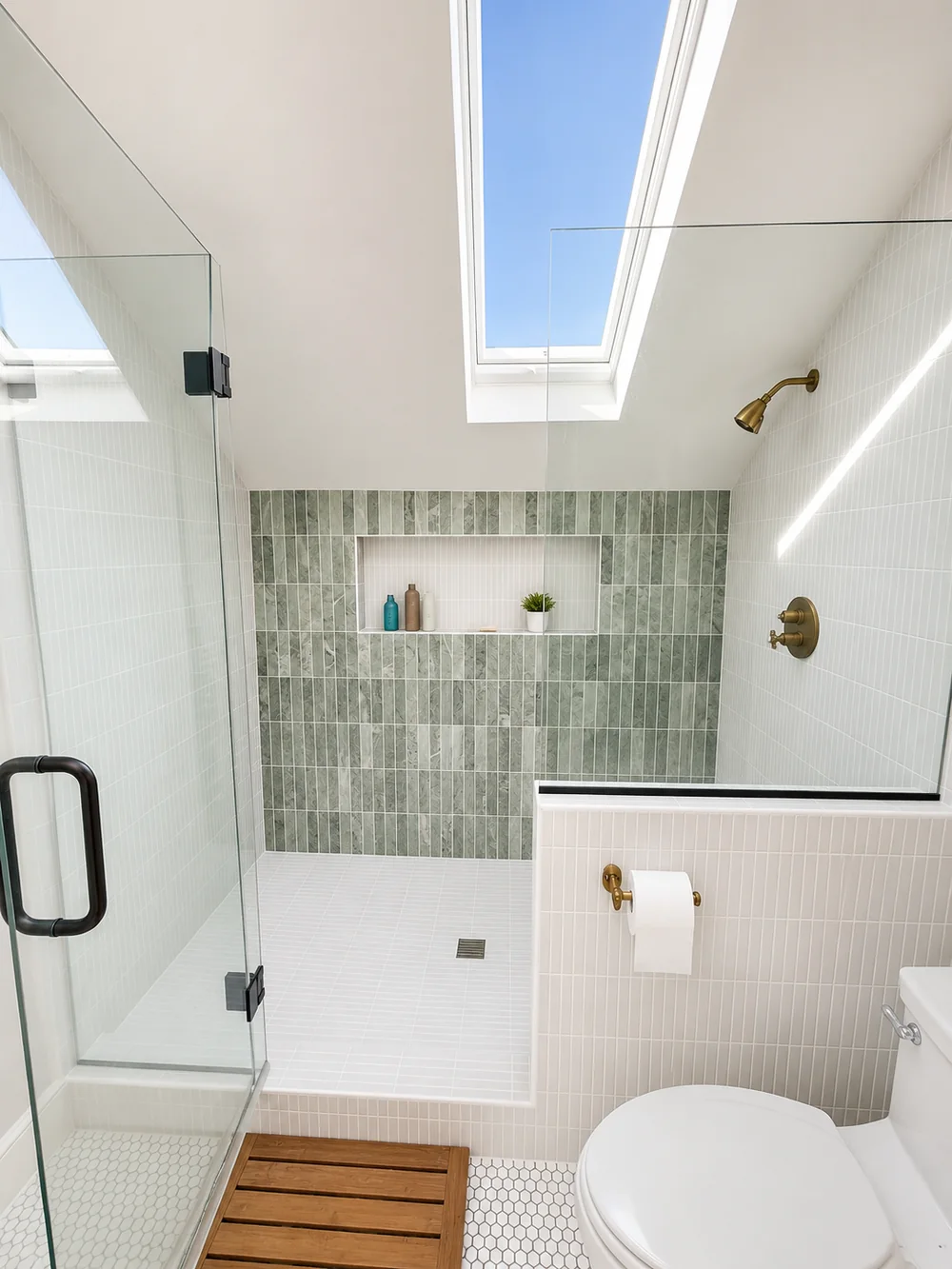
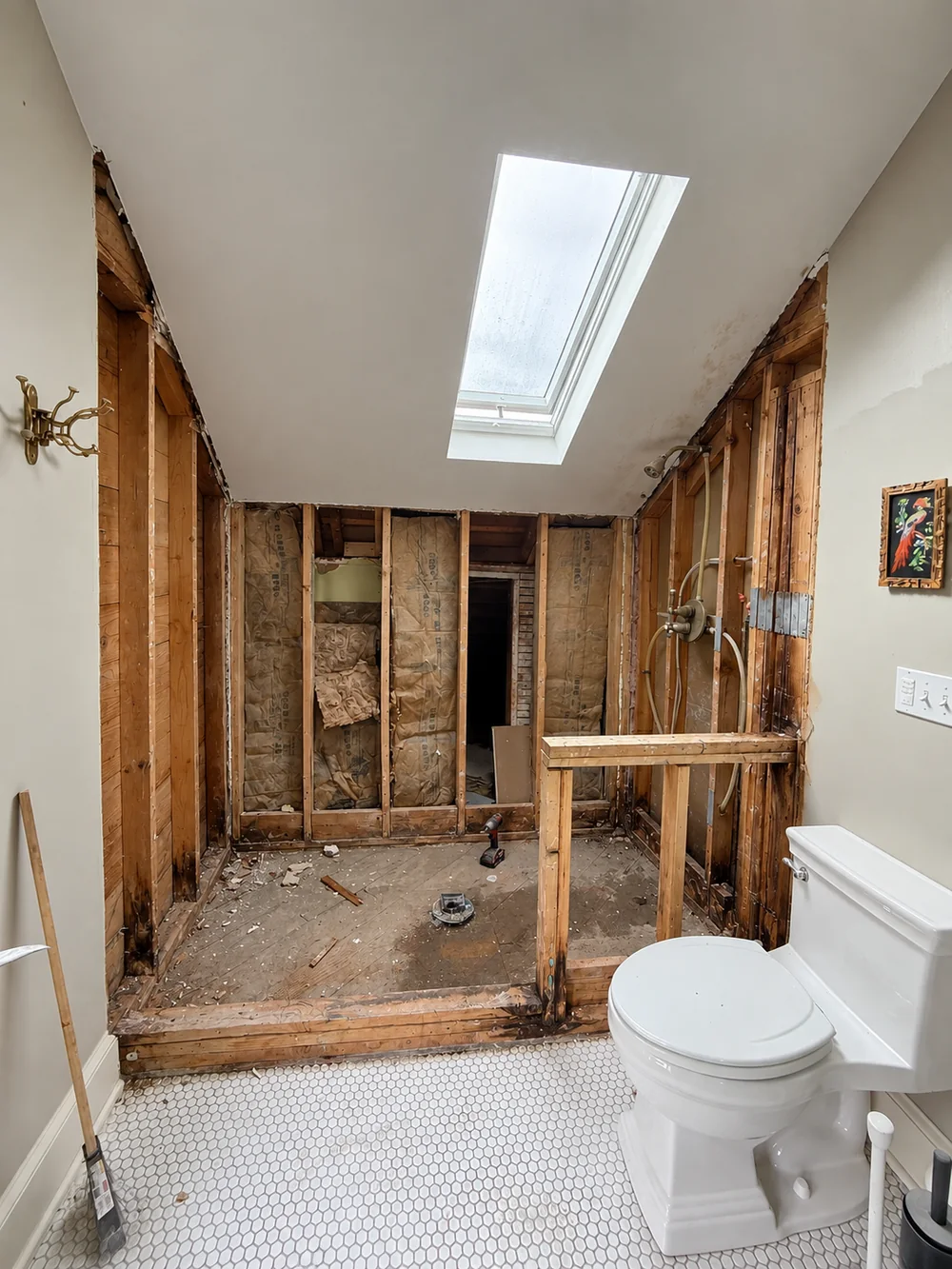 Before After
The surface damage is only ever the smaller part of the story. Rot travels along the grain beneath paint and siding, so a soft spot you can press a thumb into tells you where the problem ends, not where it started. An 1880s or 1920s house in Historic Milwaukie or Ardenwald that has absorbed a century of patch jobs and repaints over the same corner can hide a wide gap between those two points. A photo simply cannot capture that gap, and any number attached to one is closer to a guess than an estimate, a guess that tends to turn into a change order once the wall actually comes open.
That is why we walk the wall ourselves before writing anything down. The estimate keeps the two kinds of knowledge separate: the scope we can verify in person, priced firm, and the extent we can only confirm with the wall open, broken out as its own line item you sign off on before any cutting starts. You always know exactly which number on that page is guaranteed.
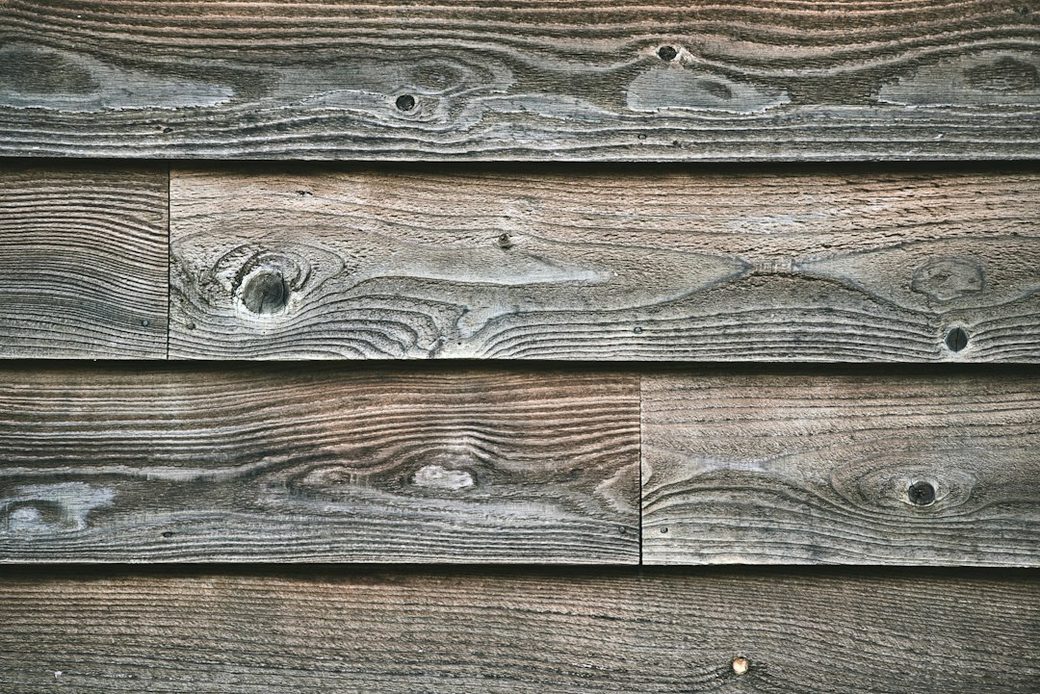
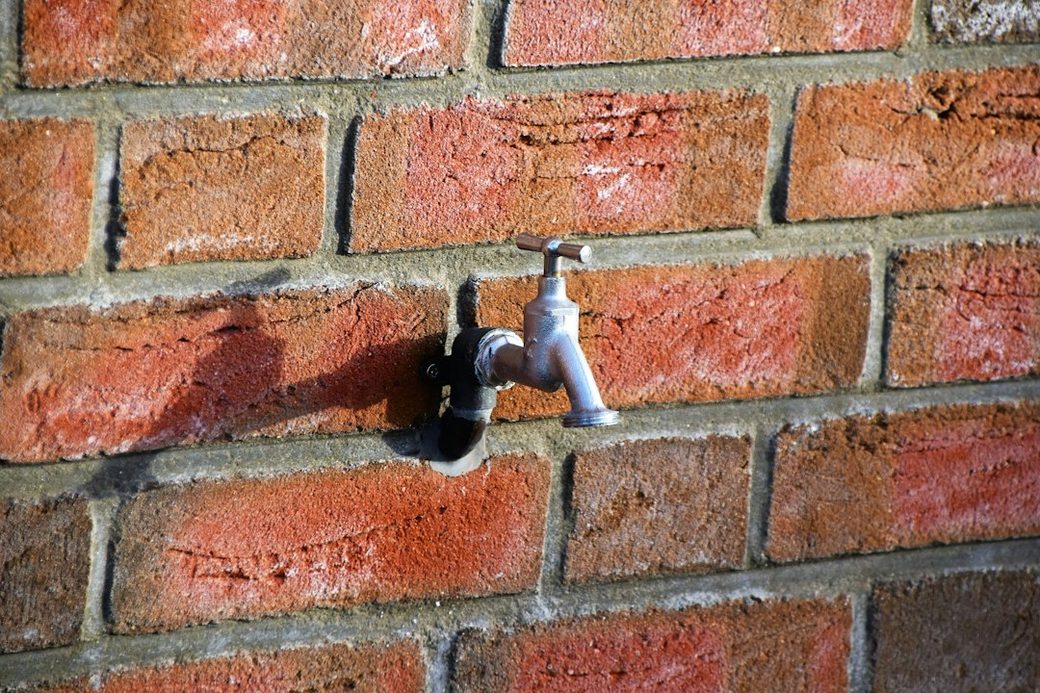
Milwaukie sits where Kellogg Creek meets the Willamette, and the older homes in Historic Milwaukie and Ardenwald have been standing through the city’s wet winters since the 1880s and 1920s. Roughly forty-three inches of rain a year, heaviest in November and December, has had a long run at whatever original trim and siding is still on these houses.
Pulling out the bad wood only solves half of this. The harder half is picking a replacement that will not land back on our schedule at the same spot a decade from now, a bigger concern on a house already past its first hundred years than on something built recently.
We start by matching what the house already wears, because the best rot repair is the one nobody can spot later. A good share of the older homes around Historic Milwaukie and Ardenwald, some dating back to the 1880s, still carry their original cedar siding and trim, so cedar milled to the same profile is what goes back up. Where that exact profile has not been cut in decades, we build it up from square stock until the reveal and the shadow line fall in with the boards on either side.
Cedar and redwood hold up because of the oil locked in the heartwood, though the sapwood sold today is a thinner version of the old growth it is replacing. Primed finger-jointed pine is the budget route and takes paint well, but it softens fast anywhere water sits, and close to the river and Kellogg Creek that is a good share of the wall, so we keep it off the dirt and away from the bottom of any trim run. Cellular PVC and fiber cement simply will not rot, which makes them the right call at the spots that keep failing: the base of a corner board, a water table, casing under a window that was never flashed at the head. The cost per foot runs higher, and it buys out a third visit to the same corner.
Framing gets its own rule. Anything bearing on a foundation or sitting close to grade comes back pressure-treated, since bare fir set against damp concrete is exactly how the original sill plate failed in the first place. Where we sister a joist or set a new stud, it is Douglas fir, sized to carry what the old piece carried rather than just fill the gap.
Fasteners matter more than people assume. The copper in modern treated lumber eats through an ordinary galvanized screw inside one wet season, so anything driven into treated stock or cedar goes in stainless or hot-dipped galvanized instead. Skip that detail and rust-colored streaks bleed down the board before the year is out, and no coat of paint ever hides them again.
Last, every piece gets primed on all six faces, cut ends included, before it is ever fastened in place. Bare end grain pulls in water the way a straw pulls a drink, and whether that single step happens is a better sign of how long a repair lasts in a river town like this than anything printed on the paint can.
Four separate questions decide how big this job actually gets, and the first two you can answer tonight without us, using just a tape measure and a pocketknife.
Is it carrying any weight? Trim, a water table, the bottom course of siding: none of that holds the house up, so a bad length there is an inconvenience and little else. A sill plate, a rim joist, a post base or a deck ledger is a different matter, because the structure depends on it, and that work means temporary shoring, sound replacement lumber, and a permit filed through the state’s BuildingPermits.Oregon.gov portal, administered by the City of Milwaukie Building Division. What actually drives the price is never the board itself. It is getting a load-bearing piece out safely without anything settling while the work happens.
How far does the soft wood actually run? Walk a screwdriver along the piece every few inches until the tip stops sinking in, then keep testing a solid foot past that last soft spot. Decay travels down the grain well ahead of anything visible in the paint, and stopping at the edge of what shows is the single most common reason a repair does not hold.
Does epoxy belong here? Occasionally, and we will say so plainly. A good consolidant and filler can rescue a shaped piece you cannot buy anymore, an old window sash, a porch post, a run of period trim off one of the Historic Milwaukie houses, as long as the rot sits in a pocket and has not gone clear through. It does nothing for anything load-bearing, and it is no way around opening a wall. Anyone offering to pour epoxy into a soft sill plate is quietly setting up your second repair.
And what sits above it? This is the one that decides whether the fix actually lasts. The water usually started somewhere upstream of the damage: a kickout missing where a roofline dies into a wall, a gutter that overflows in a hard November rain, siding packed too close to a planting bed, a deck ledger with nothing capping its top edge. We trace that source and close it first, priced on the same sheet, because new wood set under a leak that is still running just gets paid for twice.
Honestly, the final number tracks how much rot is actually back there, and nobody can say for certain until the wall or the deck is physically open. A few things are still true ahead of that moment: a contained job, limited to a short run of trim or a handful of soft deck boards, lands cheap; bring a joist, a sill or a post base into it and the price climbs, because anything load-bearing drags shoring and an inspection along with it; and nothing moves the number more than simple time, since a leak that has already survived one or two of Milwaukie’s wet Novembers only gets costlier to chase the longer it keeps running.
Where the money actually goes tends to surprise people. Material is usually the smallest line on a rot invoice. Labor and reach make up the larger share: building safe staging, pulling siding back far enough to get behind the damage, holding a load on temporary posts while a piece comes out, then closing the wall so nothing shows it was ever opened. A narrow side yard on an older Ardenwald or Historic Milwaukie lot, with barely enough room to stand a ladder, routinely costs more to work than the same repair on a house with open ground on every side.
Roughly in order, you are paying for labor first, then the weatherproofing that locks the repair in, meaning flashing, house wrap, siding, primer and a finish coat, then the lumber, and finally a permit and inspection through the state’s BuildingPermits.Oregon.gov portal if the work touches anything structural. Anything that has to come down and go back up gets its own line, a downspout, a gutter, a light fixture, a stretch of deck rail, so the wood share and the access share are easy to tell apart on the page.
If someone else has already given you a number in writing, pass it along with a couple of photos of the problem area. We typically come in under a competing written quote by 10%, or match it outright, and we will confirm that in writing before any work starts.
10%
Hand that estimate over with a photo of the damaged spot, and you will hear from us within the day if it reaches us before our five o’clock cutoff.
Nearly all of a rot repair happens outside your walls, not in the rooms you actually live in, so it ranks among the calmer remodels to have running on an older Milwaukie house. Here is the shape it generally takes.
Before anything comes off, we walk the property together, flag what is being removed, and figure out where the dumpster, staging and lumber pile should go, usually a tighter puzzle on a narrow century-old lot in Historic Milwaukie or Ardenwald than on a wider parcel further out. Whatever could be damaged close to that wall gets carried somewhere safer first, whether that is you handling it or the crew.
This is the day with the noise and the dust. Siding and trim come off across the morning hours, and by early afternoon the bare framing is sitting out in plain view for the first time. Whatever that framing shows is the real answer to the possible-extent line on your estimate, not a guess made from the sidewalk beforehand.
If the wall hides more damage than the number we quoted assumed, you hear from us before the day is over, photos attached, and no further cutting happens in the meantime. None of that additional work starts until you have told us to proceed.
If a storm is closing in before the framing is finished, the crew wraps and tapes the opening airtight rather than risk it overnight, but the usual sequence is framing first, then sheathing, then flashing and house wrap before anyone leaves for the day, since this town gets enough rain that an open wall left waiting until tomorrow just starts the same problem over again.
Siding returns to the wall first, trim comes next, and a bead of sealant plus a coat of primer close out the exterior sequence. From the street the house already looks complete at this stage, and more than once that is the exact moment somebody walking a dog on an Ardenwald or Historic Milwaukie block stops to ask for a card.
The final coat is the last step, followed by a thorough cleanup of the yard and a walkthrough where we check the finished work against the estimate point by point with you. Every offcut, every piece of rotted wood we pulled, and the dumpster itself leave with the crew.
Press a screwdriver tip into it, or even a house key. Sound wood resists; rotten wood gives way, feels spongy, or crumbles into damp pieces, and the paint over it has usually already started cracking or lifting in patches. If the tip sinks in with almost no push, the wood underneath is already compromised. Either way, a photo and a short note get you an answer, and anything reaching us before 5pm gets a reply that same day.
Sometimes, yes, and when that is genuinely the whole problem we tell you so. But rot does not stop at the edge of what you noticed; it keeps working through the wood hidden behind the patch, and covering it with new siding instead of following it to where it actually ends just means paying for the same repair again later, usually at a higher price once it resurfaces.
On a house with any real age to it, that is common enough that we plan for it up front rather than surprise you with it afterward. The estimate separates what we can see and confirm before we start from the extent we might uncover once the siding comes off, and that second figure sits on its own line. Nothing on it moves forward until you have seen the photos and said go ahead.
That depends on your specific policy and on what actually let the water in, which makes it a question for your insurance company, not for us. What we can do is document everything as we find it, photographs and measurements the moment the wall or the deck comes open, dated as we go, so you have real evidence to bring to an adjuster if you decide a claim is worth filing.
We do, whenever the scope calls for one. Rebuilding a sill plate, a rim joist, a post base, or the framing that ties a deck into the house touches the structure, and for a Milwaukie address that permit and its inspection are filed through the state’s BuildingPermits.Oregon.gov portal, administered by the City of Milwaukie Building Division, rather than through Clackamas County directly. Holding an Oregon contractor license, CCB #262707, means we handle that filing and book every inspection ourselves. Straightforward cosmetic trim or siding work with nothing structural behind it usually needs none of this.
A contained trim or siding repair typically wraps in a day, sometimes two. Anything structural runs longer, since the shoring, the inspection and the drying in all have to happen in order, and paint will not cure properly in wet weather, which matters most through Milwaukie’s wetter months of November and December. You get an actual day count written into the estimate ahead of time. You do not need to be home for most of it, though we like to be reachable the day the wall actually opens, in case a decision is waiting on you.
In most cases, yes. Many of the profiles on the older homes around Historic Milwaukie and Ardenwald are either still milled today or can be run to order, and for anything genuinely out of production we build it up from plain stock until the reveal lines up with the boards already on the wall. Paint is simpler still: an old can or a code pulled from it speeds things along, and without either, we color match directly from a chip taken off the house.
Summer simplifies things, roughly late June through September, since the opening stays exposed for the shortest stretch of time in that window. That said, we take these jobs year round and weatherproof each section the same day we reach it, not all at once at the end of the week. Waiting for dry weather before calling almost never pays off here, since a leak active through a Milwaukie winter keeps spreading while you wait, and a small repair now costs less than the bigger one discovered next spring.
Evergreen’s shop sits at 505 SE 184th Avenue in east Vancouver. Reaching Milwaukie, the self-styled Dogwood City of the West and home of the original Bing cherry, means crossing the Columbia on I-205 and continuing south through Portland on I-5 or McLoughlin Boulevard to the east bank of the Willamette, a regular stretch of the week for this crew rather than a special trip. Once here, we take on rot work across the old downtown core along SE Main Street in Historic Milwaukie, the early-twentieth-century streets of Ardenwald and Hector Campbell, the river frontage at Island Station, and the Lake Road, Lewelling and Linwood districts further from the water, in a city that has made its living from shipping and manufacturing since Lot Whitcomb platted it in 1849. Licensed in Oregon, CCB #262707.
Three of the 50 reviews on our Google profile, in the homeowners' own words.
David's work was terrific. Repaired a rotted out structural framing issue in a bathroom and replaced (and resized!) a window in the same space. He initially quoted a two day job but was able to finish in a single day. Dedicated! Will be using him again.
Joe H.Bathroom framing repair
We talked to 4 different contractors and only David, of Evergreen, took the time to climb up to our roof to check out the job. The others gave us bids based upon a photo. Evergreen was not the cheapest but the extent of the work they did was worth every penny.
Steve K.Roof and exterior work
Evergreen crew installed three skylights for us. Once we opened the ceiling there was more to do than expected and they handled it without drama. Clean work, fair price, and they cleaned up after themselves.
Foad M.Three skylights
Send photos and a short description. If it arrives before 5pm you get an answer the same day.
Already have a written estimate from someone else? Send that too. We match or beat most estimates by 10%.
Built for the wet side of the river.

Licensed and insured remodeling contractor serving Vancouver, WA and the Portland metro.
Oregon CCB #262707 · WA Lic. #EVERGRS757MCEvergreen Renewal Services LLC
505 SE 184th Ave Unit 320
Vancouver, WA 98683
© 2026 Evergreen Remodeling. Oregon CCB #262707 · WA Lic. #EVERGRS757MC. Evergreen Renewal Services LLC. All rights reserved.
Same day response on anything sent before 5pm.