

Around Hazel Dell the housing runs mostly mid-century, ranch and post-war places that went up along the old Highway 99 corridor between the 1950s and the 1970s, with a few orchard-era farmhouses still mixed in. Those homes carry decades of original material behind the walls, so a job you booked as a kitchen update can turn up early wiring, galvanized supply lines, or a patch of rot the siding had been hiding. Work like that seldom stays inside one trade, a floor wanting carpentry, plumbing, wiring and finish all at once, and that is the kind of thing one owner-run crew should carry. We go at it the same way every time: get in behind the finish, find what has actually gone wrong, set the cause right, and put things back so you would never know we had opened it up.
Licensed and insured. WA Lic. #EVERGRS757MC
On anything sent before 5pm
We match or beat most written estimates
Remodels completed
A bare lower level made livable, a dated main floor given new life, or the full house in a single run.
We dig out whatever started it, correct it at the source, and hand the room back stronger than it was before.
The items your realtor flagged, taken care of by one crew on a single calendar before the photos.
In a mid-century house, new drywall, doors and flooring sit right beside original surfaces, and careless finish work makes the whole job look pieced together. We match wall texture, trim profiles and floor heights, then paint, all with one crew that owns how each room looks when it is done.
Fixing a leaky trap or patching a hole in a wall is a good handyman job. Opening a wall in a mid-century house is different, since old wiring, plumbing and framing can come along with it, and once permits, structural changes or more than one trade are involved, the job has outgrown a handyman and needs a licensed contractor.
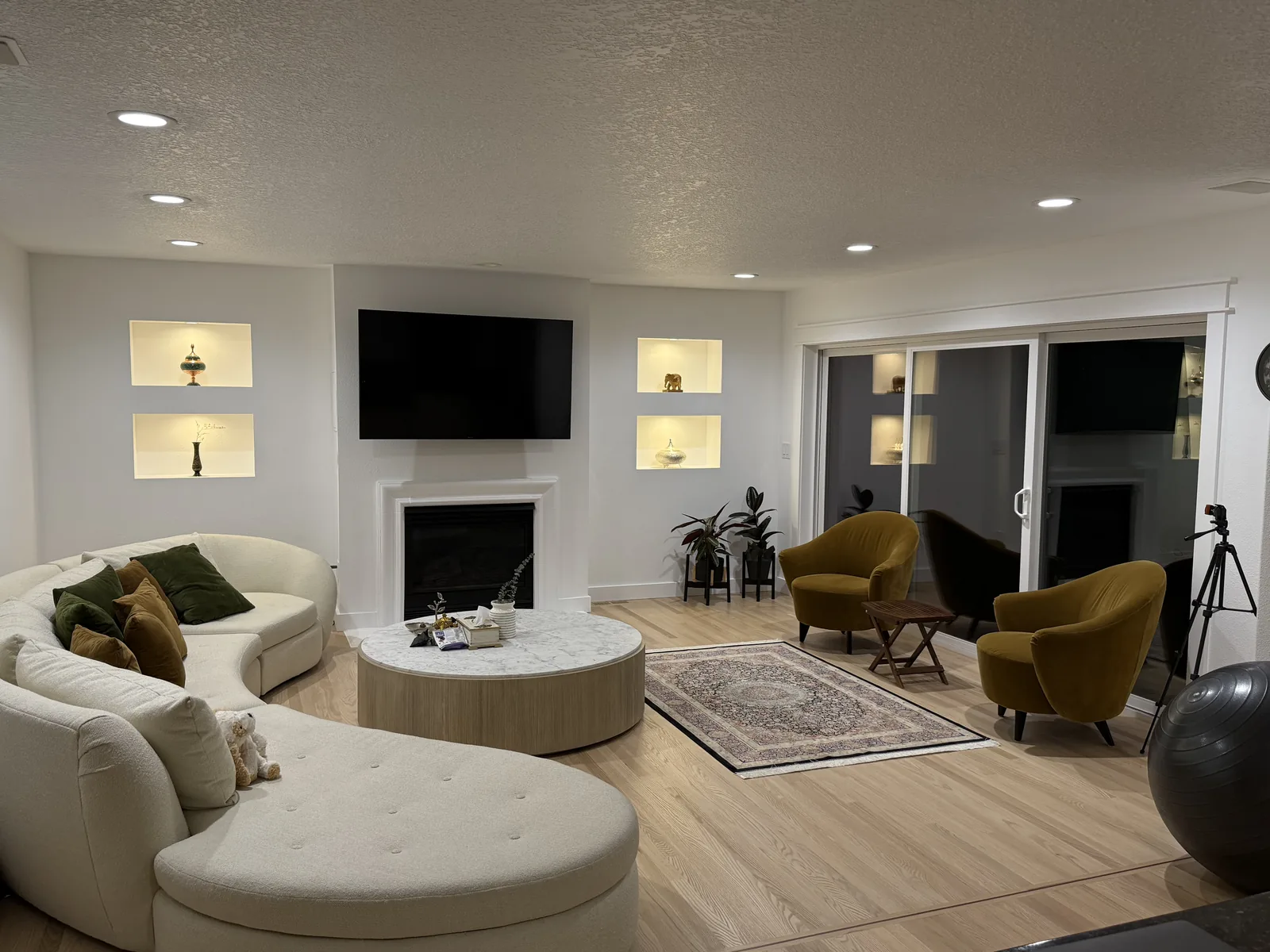
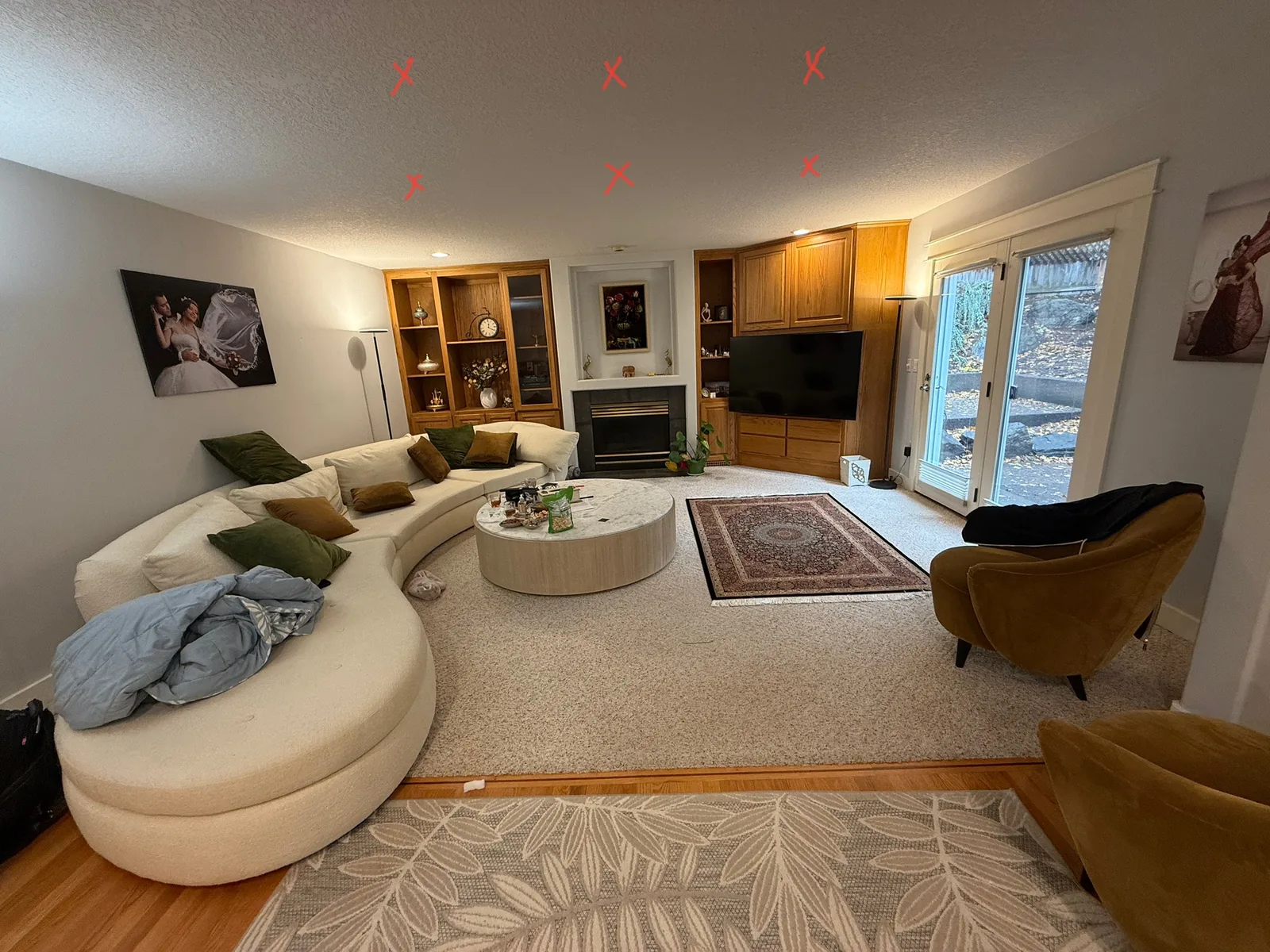
A living room is mostly built-ins, ceiling and light. This is the same corner before the crew started and after they left.
Drag the handle. Left, the room as it was: oak built-ins either side of the fireplace, a textured ceiling, and the marks on it where the new lights would go. Right, the same room finished: the built-ins rebuilt in white with lit niches, and the ceiling done.
 Before After
When a remodel runs several trades at once, the trouble almost never comes from the carpentry or the tile. It comes from the seams between them, finish flooring going down before the plumbing clears inspection, an order that never got placed, each sub taking it for granted that someone else set up the county visit. The only way those seams ever close is one person keeping the full schedule straight after having walked the place to build it. David does that himself. He works up the price and he stays on site to run the job, so the number you call on day one still reaches him when the last trade pulls out.
The rooms are different each time and so is the budget, but a short, familiar set of questions appears on just about every Hazel Dell walkthrough. This is how we sort through each one at your side.
Flooring usually gets settled first, since whatever goes down sits under every trade that comes after. With damp hanging around most of the year, plenty of owners here land on luxury vinyl plank: it sheds water, it hushes the room, and a single wrecked plank lifts out without touching the rest, though at arm’s length no one takes it for timber. Engineered flooring carries a real hardwood top layer over a core that stays put, so it shrugs off the damp-season movement that leaves solid planks warped, and you can sand it back once or twice. Solid hardwood lasts for generations and is also the first to buckle the morning a line behind the fridge lets go. Tile will outwear everything and is cold to stand on in January. The real question under all of it is how rough a life the floor is in for: a pack of dogs and kids, a concrete slab on the level below, or two people who hardly leave a mark.
A homeowner rarely shows up with an opinion on how the walls get finished. Pull a cover plate in a 1950s or 1960s house around here and you may find early drywall taped to a grade no one would sign off on today, or a run of hand-floated plaster, and knitting new work into either without a seam showing takes a skim coat or a finisher who will not be rushed. On fresh board, what you actually pay for is how far the finish is taken. A level four is the standard, and it still gives up every seam when a low sun crosses the wall; a level five skim coat costs more and is worth the extra on any lengthy wall sitting across from a window. The paint sheen does something similar: a flat swallows blemishes, a satin wipes clean, and wherever light grazes a wall from one side, the flat keeps those joints from ever showing.
Nothing shows a home’s age faster than the doors and the trim, leaving paint out of it. Hang a hollow slab and it announces its price with a tinny knock every time it closes; spend on a solid one and the room feels finished the instant it latches. For the casing and base, reproduce the trim the house came with instead of pulling a stock length off the rack, and if none of the old profile is worth keeping, choose one and use it through every room. Spot three different casings in a single hallway and you have the whole story: three owners, three remodels, and not one of them comparing notes with the last.
With a wall or ceiling already open, two things are cheap today that turn brutal to add down the road. Insulation leads the list, doing the most good on walls that share a line with an unheated garage and in those dim rooms on the shaded side of the house, where decades of canopy overhead keep the heat from holding across a damp winter. Wiring is the other one: slip in a spare circuit, cap a stub toward the exhaust fan you will want sooner or later in this damp, run a cable to the wall the television will hang on, add a plug where that permanent extension cord currently lives. With the bay still open all of it runs next to nothing, and once the wall is buttoned up, prying it back apart to do any of it is where the real bill comes from.
The last thing to settle is running order, and it shifts a job more than most people would guess. Water work, structural work and anything on the roof all go first, with no exceptions, since the finishes go in last and a problem below them will wreck what sits above. The dust-making trades fall in behind, the messy ones behind them, and painting closes the whole thing out. The very same scope, worked in that order, comes in under the same scope tackled in whatever order it first came to you, and nailing that order down before day one is most of the reason a general contractor is in the job at all.
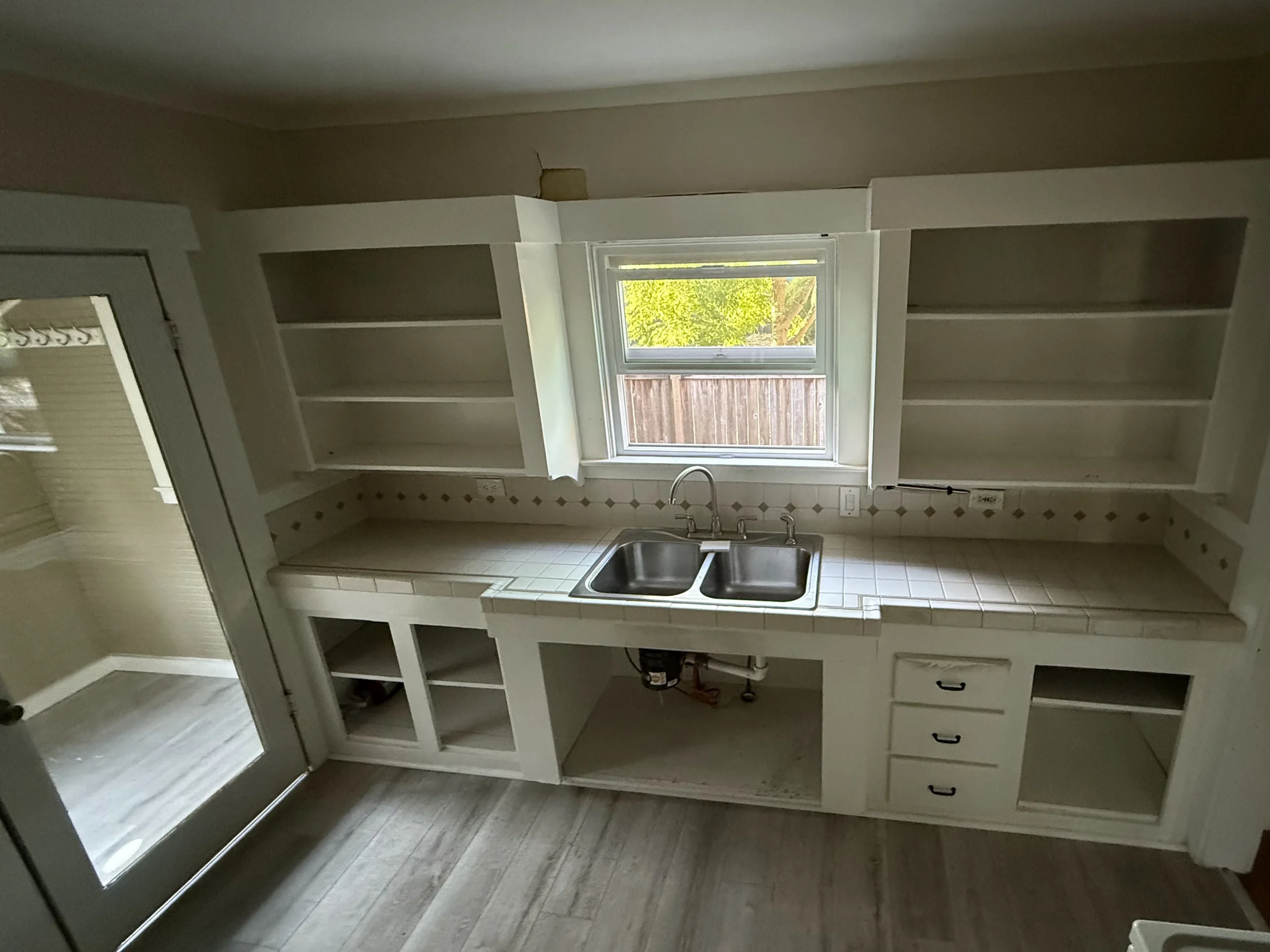
This is a job photographed partway through, with the work still out in the open, and it shows the everyday of general remodeling better than a staged final photo ever would. The wall cabinets are standing with their doors removed and nothing left on the shelves. The cabinet under the sink is wide open, and you can see straight down to the drain lines. The tile counter and its diamond accent backsplash are staying, so they sit exactly as they were, and the two-basin sink has not moved from under the window.
What matters here is the contrast. None of it was taken apart to make a picture look good. Those doors came off to get reworked away from the room, the sink base is open because what sat beneath it had to be dealt with, and the counter is still here only because it was always meant to stay. Take a kitchen a step at a time, letting each trade finish before the next starts instead of stacking them all into one week, and a morning like this is simply normal.
This is also where a scattered wish list finally becomes a schedule. Once the doors are off and that base is open, it is finally plain which parts hold up, which want attention, and which are fine untouched, and that is a judgment best reached with the owner standing right beside the work. On a project this size, a solid share of the final savings is nothing more than deciding what stays put.
A good many of these jobs begin as one thing and become another the moment a wall comes open. A mid-century house along the corridor may be hiding early wiring the last owner never got to, galvanized pipe choked down to a trickle, or a stud the damp has been working on behind the original siding. Because wood rot and structural work are what we are known for, finding one does not bring the job to a halt or have you lining up a second contractor. That one repair becomes a priced line of its own, the call stays yours, and nothing else on the schedule has to wait on it. The remodel you came for then sits over a repair that was set right, and that is the only reason it will still be sound years from now.
General work is quoted off the scope, so the number comes back split apart, a line for each room and each trade rather than one total, drywall here, flooring there, the wiring on its own. That makes paring the budget back easy, because every line shows you exactly what you keep by striking it. It also gives you an honest way to weigh a second opinion. Send over a written quote another contractor gave you for the same scope, and we match or beat most estimates by 10%, in writing.
What carries the cost is wholly a matter of what you put on the list, which is precisely why the estimate is broken out and not boiled down to one number. As a rule the labor is where most of each line goes, and the finish crews take more hours than you would guess, floating joints, cutting trim, hanging doors, laying on paint, almost pure labor with barely any stock to it. Flooring is the exception, where the material leads. Opening up a wall or a floor stands in a category of its own, charged as the labor plus whatever turns up once it is open.
Which order the trades run in decides the price as surely as it decides the finish date. Fix cabinets to walls still waiting on float and tape, and you will pull plenty of them back down to get the finishers in. Lay flooring while the dust-making trades are still at it and you will live under floor cover for weeks or pay to set it twice. An identical scope, run in the right order, lands cheaper than the same scope chased in whatever order the jobs first occurred to you, and mapping that order before a tool comes out is a good share of what a general contractor is actually for.
10%
Forward it over in whatever form you have. Even a blurry picture of the page is all we need. Have it to us by 5pm and you hear back that same day.
Nearly all of these go on with the family still in the house, so the order of the work is built around keeping daily life going. Here is the usual run of it.
We go room to room through the house with your list open, adding anything I turn up that you have not written down. The work that genuinely has to be done gets separated from the work you would like done, each side priced on its own, so deciding what makes the final cut stays your call.
Anything that has to be ordered ahead goes in on the first day, the interior doors, the flooring and the tile, the fixtures, whatever is made to a measurement. Then each trade is dropped into the order it will arrive in, and that running order becomes the plan: framing and plumbing lead, the dust-heavy work follows, and the paint is the last thing down.
Before any tools come out, we put protection over the floors on the route the crew uses, close off the active room behind dust sheeting, pick an entrance and exit that steer clear of where you actually live, and set the daily start and stop times. For anyone staying in the home through the project, we hold one room back untouched and fully your own.
Here is the structural stage, the framing, the plumbing, the electrical, anything that holds weight, with permits filed and inspections set up through the Clark County permit center. Hazel Dell sits outside any city, so the county does the permitting and inspecting, not a local building office. It is the noisy, dust-filled part of the job, and we run it through in one continuous push instead of returning to it two or three separate times.
Drywall gets taped and floated, the base and casing go on, the doors are set, the floor and tile go down, and each room is closed out before the next one opens. You take the house back a room at a time as we move along, rather than living in one stripped-out job site right up to the last day.
The painting comes dead last. When it has dried, you and I go over the completed job and make the punch list right there, because anything you raise with us still on site is far less trouble than something you spot a month after the crew has cleared out.
There is no clean one-size answer, and I am not going to pin a number on it just to land the work. What runs the clock is how long made-to-order pieces take to show up, the stages Clark County has to inspect and clear before the next can begin, and whatever a house from the 1950s or 60s is holding once we get the walls open. You come away from the walk with a window I am willing to put my name to, and if anything slides it, you hear the why from me that same day, not at the finish.
Often, yes. The second a job reroutes plumbing or a gas line, reworks the wiring, drops a wall that carries weight, or gets into anything structural, a permit is required. Hazel Dell sits outside any city, so there is no local building counter to visit, and the work is permitted and inspected by Clark County through its permit center. Filing the application and standing on site for the inspector is our job, so you never end up chasing forms. Every so often a broad opening or a long structural span needs engineered, stamped drawings, and if yours does, you will hear it at the quote.
In a mid-century house, expect to meet at least one thing nobody knew was there, a run of early wiring that only got half updated, galvanized or cast-iron pipe choked down with age, a framing member the moisture has been feeding on behind the original siding. Running into one does not throw the whole estimate back open or bring everything to a standstill. We price that one item on its own line, lay it out for you, and the call is yours while the rest of the job carries on.
Hiding that join is the hard part of working on a house this old. In a mid-century home you are usually tying new work into early drywall or hand-floated plaster and into trim cut to a profile the yards stopped carrying years back. So we run the same casing and base the house came with instead of the closest thing on the rack, blend the fresh drywall or plaster into what is already there, and carry the paint across so no line marks where ours starts. Put the real trouble right down underneath, and up top there is nothing left to give it away.
There is no one for you to coordinate. The crew runs under its owner, so David himself works up the price, decides which trade follows which, and is on the site calling the shots as the work raises them. Where a specialty trade has to be licensed, it lines up on our schedule and builds to the standard we set, and we are the ones accountable top to bottom. One project, a single plan, and one person who answers for how it turns out.
Yes, nearly every time, and most owners choose to. It all hangs on keeping the dust walled off and the stages in the right order: the room being worked gets shut behind a zippered barrier, the path you use day to day stays covered, and the phases line up so you are never short a kitchen and a bath at the same moment. We settle the on-site hours before the first morning, so your evenings and weekends stay your own.
Inside the house, very little. Hanging drywall, laying floors and running finish trim all carry on fine through the rainy months. The weather only becomes a factor the day we open the skin of the house, a door swapped out, a fresh window let into a wall, siding stripped back to get at the rot beneath. With damp that lingers from fall into late spring and a heavy tree canopy that keeps the shaded side from drying out between storms, we slot that outdoor work into the dry window from late June through September, and we keep every opening under cover until the wall is closed up again.
It takes very little, really. Send over a few pictures and a line on the work you have in mind and that is enough to begin, no need to make it neat first. If it lands with us before 5pm, you get an answer the same day. And if you already have a written bid from another company covering the same work, pass that along as well, since we match or beat most estimates by 10%.
We keep our shop at 505 SE 184th Ave in Vancouver, a quick drive up to Hazel Dell with no bridge in the way. Our remodels run right across the community: the mid-century ranch and post-war houses along the Highway 99 corridor and the quiet streets off it, homes through Hazel Dell North and Hazel Dell South, the lower lots toward Burnt Bridge and Cougar Creek, and outward into Minnehaha, Walnut Grove and the north end of Vancouver.
Three of the 50 reviews on our Google profile, in the homeowners' own words.
We had a small but very unique project and this team handled it with a great attitude. They were responsive, on time, and the finished work looks like it was always meant to be there.
Paige T.Small custom project
David the owner came by for a quote and was able to get us scheduled right away. The communication was great with his team and the guys were on time and very professional. Would highly recommend.
Scott G.Kitchen nook bench
We talked to 4 different contractors and only David, of Evergreen, took the time to climb up to our roof to check out the job. The others gave us bids based upon a photo. Evergreen was not the cheapest but the extent of the work they did was worth every penny.
Steve K.Roof and exterior work
Send photos and a short description. If it arrives before 5pm you get an answer the same day.
Already have a written estimate from someone else? Send that too. We match or beat most estimates by 10%.
Built for the wet side of the river.

Licensed and insured remodeling contractor serving Vancouver, WA and the Portland metro.
Oregon CCB #262707 · WA Lic. #EVERGRS757MCEvergreen Renewal Services LLC
505 SE 184th Ave Unit 320
Vancouver, WA 98683
© 2026 Evergreen Remodeling. Oregon CCB #262707 · WA Lic. #EVERGRS757MC. Evergreen Renewal Services LLC. All rights reserved.
Same day response on anything sent before 5pm.