

One repair, five ways into town
A crossroads community rarely grows on one schedule, and Five Corners did not either. Interstate 205 forms its southwest edge and Washington State Route 503 runs along the east side. Between those roads and neighbors like Walnut Grove, Brush Prairie, Orchards and the city of Vancouver itself, this ground filled in over many different decades rather than all at once. That is why a street here can carry a house raised decades ago standing a few lots from one finished far more recently, each wearing whatever materials its own building period actually used. Somewhere around 44 to 46 inches of rain a year gives every one of those generations the same long chance to find a weak seam. A house fronting the I-205 or SR-503 edges takes it harder than one set back on an interior street, with more direct weather off two busy roads plus the fine grit and spray that passing traffic keeps throwing onto siding and trim even after a storm has cleared.
Licensed and insured. WA Lic. #EVERGRS757MC
On anything sent before 5pm
We match or beat most written estimates
Remodels completed
Across enough wet seasons, water works into nearly the same handful of joints on almost any exterior. In Five Corners those joints give out a little sooner on anything facing one of the two highway edges, and here is where we open things up most:
A house fronting SR-503 or sitting right along the I-205 side carries a layer of road grit that interior-street homes rarely see, and that grime cakes into the grain at the base of a corner board or along a water table and holds moisture there well after the rain itself has stopped. On almost any house here, these are usually the first pieces to give: corner boards, the casing wrapped around windows and doors, water tables and belly bands, and the sheathing tucked in behind all of it.
Soft decking, the joists and beams underneath it, and the ledger bolting the whole structure back to the house all wear out here, and the ledger connection usually gives out first. A deck added onto an older home after the fact and one that came standard with a newer build fail for different reasons: the older ledger was rarely flashed the way code requires today, while the newer one is more often let down by builder-grade fasteners already starting to corrode. Either way, that bolted connection is where we look first.
A sill plate low against the foundation, the rim joist running above it, the base of a wall stud, or the footing beneath a support post can draw dampness out of wet soil for years before any of it shows on the surface. We see it most in crawlspaces under older homes, where the surrounding ground has had the longest stretch of time to settle and hold water close against the foundation. A newer build is not automatically spared, though, if nobody ever graded that particular lot to move water away from the house.
Flashing above a window or door that quietly stopped doing its job years ago keeps feeding a little more rain in behind the trim with every storm since. Because homes here went up over many decades and under many different builders, that flashing was never installed to one single standard to begin with. On a house nearer the I-205 or SR-503 frontage, wind-driven rain off the roadway finds that failure faster than it would on a sheltered interior lot, so the cavity behind the trim starts filling sooner even when the flashing itself is no older.
A supply line or a shower pan seeping quietly for months will soften a subfloor the same way no matter how old the plumbing behind the wall is. The bathroom above a softened floor might be original to a house that went up before the surrounding area ever filled in, or it might belong to a house finished five years ago on a lot that was still open ground not long before that.
A quick picture of the spot, plus a line on what has you wondering, is all it takes to get this moving. Messages that land with us ahead of the 5pm cutoff get answered that same afternoon, no matter which stretch of Five Corners you are calling from, whether that is near the interstate, off SR-503, or somewhere in between. Should this turn out to be work that belongs to a different trade altogether, we will say so honestly rather than take on a job that was never ours.
On rot work this is the only proof that means anything. A finished photo shows a wall. A pair shows what was behind it.
Drag the handle. Left, the framing behind a failed shower, exposed once demolition was done. Right, the same spot finished with a waterproofed, tiled walk-in shower and a glass enclosure.
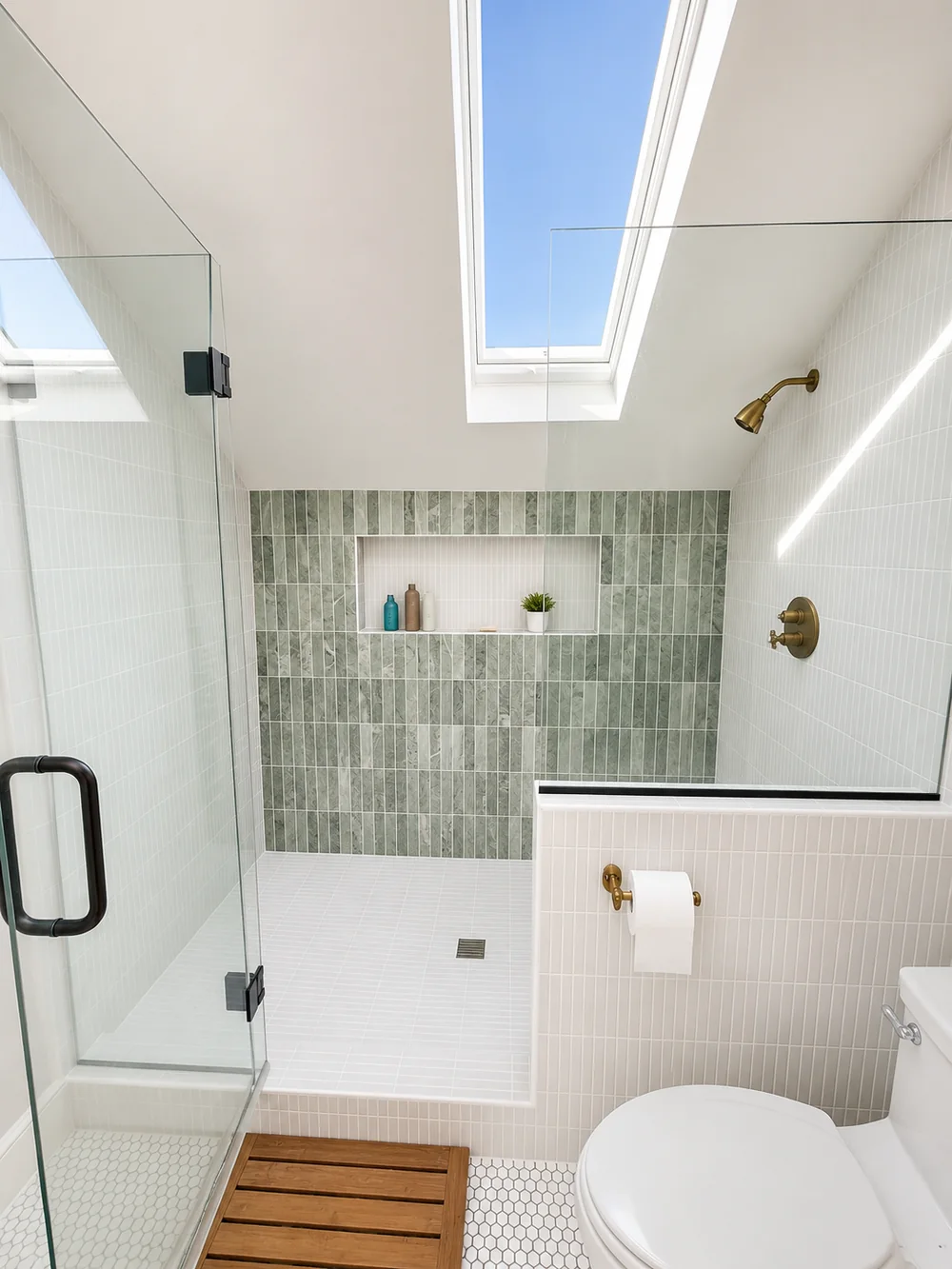
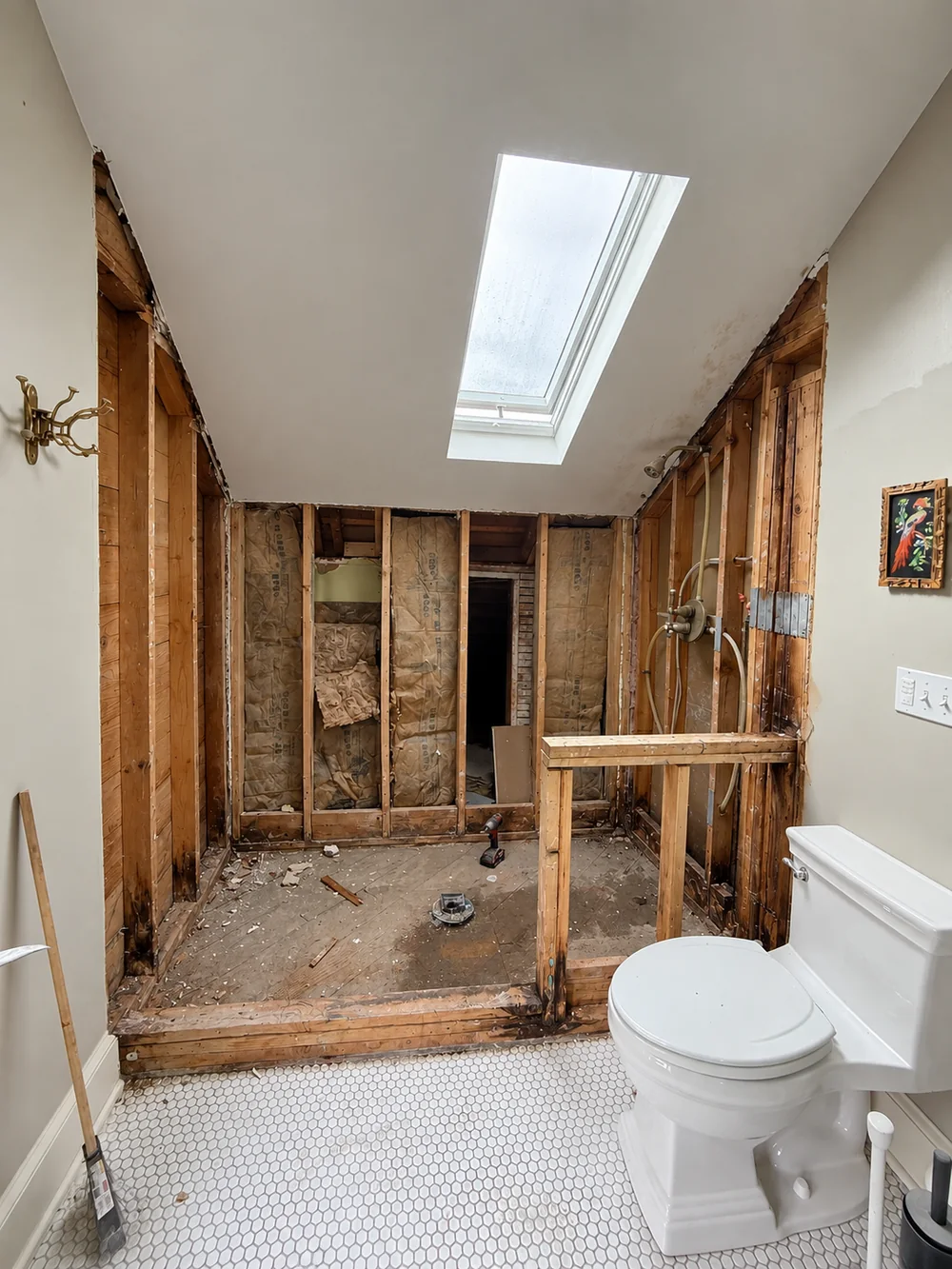 Before After
A soft spot you can press with your own thumb only marks where the decay finally ran out of material to work through, not where water actually slipped past a seam years earlier. Rot moves inside the grain behind paint and siding long before any of that reaches daylight. A soft patch near the Orchards side and a same-looking patch over toward Walnut Grove can be hiding entirely different amounts of damage, simply because the two houses may not share a build year or the same materials. Quoting a price off a picture means quoting a guess, and that guess turns into an unwelcome surprise the moment the wall is actually opened.
That is exactly why someone from this crew walks the actual wall with you before a single number gets written down. Whatever we can verify without removing anything becomes a fixed line item. Whatever only an opened wall can answer gets listed apart on its own, marked plainly as a possible cost, and none of it turns into billed work until you have reviewed photographs and told us to go ahead.
Five Corners fits its name as a crossroads. Interstate 205 runs along its southwest edge and Washington State Route 503 marks the eastern one. The community sits boxed in by Walnut Grove to the southwest, a neighboring area to the northwest, Brush Prairie to the north, Orchards to the east, and the city of Vancouver itself to the south. The 2020 census counted 20,973 people inside those borders. Homes here went up across many different decades rather than all at once, which is why no single decade and no single builder ever got to define this particular stretch of houses.
Cutting the rot out is the quick half of this job. The half that actually decides whether we are back at this same corner in another decade is the material that goes back in its place, and in Five Corners that decision looks different depending on when your particular house was built.
What is already nailed to a particular house decides where we start, not what happens to be standard on the block behind it. An older home here often still wears real cedar siding and trim, and cedar is exactly what goes back on, cut to match the reveal already there. Once a specific profile has genuinely disappeared from every supplier’s shelf, we laminate a replacement from raw stock until the shadow lines on either side blend together.
Heartwood from an old-growth tree holds natural oils that nothing milled today fully replicates, which is why original cedar so often outlasts whatever eventually replaces it. A primed, finger-jointed pine board costs less and takes paint beautifully, but it turns soft once it sits somewhere that never fully dries out. A wall absorbing extra spray off I-205 or SR-503 rarely gets the chance to dry, so pine stays away from grade and away from the lowest run of any trim near either road. Cellular PVC and fiber cement, on the other hand, simply do not rot, making either one the smarter pick anywhere that has already failed once: a corner board’s base, a water table, or the casing beneath a window missing its head flashing.
Structural lumber answers to a separate rule entirely. Any piece touching concrete, or sitting close enough to the dirt to matter, comes back pressure-treated, because ordinary fir left resting on a damp slab for years is usually how the original piece failed to begin with. When a joist needs a sister or a stud needs full replacement, the new piece goes in as Douglas fir, sized to the load the old piece actually carried rather than simply cut to fit the hole.
Hardware tends to announce a shortcut repair before the wood itself does. Today’s treated lumber carries enough copper to corrode a plain zinc screw within a single year, leaving a rust-colored bleed streaking down a board that was only just installed. Every fastener this crew drives into cedar or pressure-treated stock is either stainless steel or heavy hot-dip galvanized, since replacing one screw costs far less than tearing out and replacing the board it ruined.
One step matters more than whichever paint brand ends up on the final coat: sealing all six faces of a new piece, cut ends included, before it ever touches a nail. An unsealed end grain soaks up water the way a paper towel does, far quicker than any flat face will. Whether that step actually happens tends to be the real answer to how long a repair holds.
What actually sets the size of a Five Corners rot job comes down to four separate factors, not the two or three most homeowners assume. The first pair are yours to check tonight on your own: grab a screwdriver and a spare few minutes and you are set.
Does this particular piece actually bear weight? Trim, a water table, a bottom run of siding: none of those hold the house up, so a bad length of any of them stays a cheap, quick fix. A rim joist, a sill plate, a post base or a deck’s ledger connection is a different story, since the building itself depends on it. Because Five Corners sits outside any city’s limits, that kind of carpentry gets permitted through Clark County Building Safety, with temporary shoring and a county inspector both part of the process. The jump in cost there has nothing to do with lumber prices. It comes from the extra steps required to remove a load-bearing piece safely.
Second, how far has the damage actually traveled past what you can see? Instead of trusting the stain, press a screwdriver tip along the grain in small increments, working outward from the obvious spot, until the wood resists again firmly for a real stretch, then keep probing another foot beyond that point anyway. Decay moves through the fiber long before the surface gives any sign of it, and treating the visible patch as the whole problem is the single most common reason this crew ends up back at the same corner a year later.
Third, is a wood consolidant ever a legitimate stand-in for actually removing the piece? Sometimes, and we will tell you so honestly rather than sell you a shortcut. A good epoxy filler genuinely works on an ornamental profile that nobody makes anymore, provided the decay is a shallow pocket rather than something that has eaten clean through. None of that applies once a load-bearing member is involved, and it is never a legitimate way to put off opening a wall that genuinely needs opening.
Fourth, and maybe most important, what is actually sending water to this one spot? On a lot sitting close to a busy road, road spray is part of the answer, but just as often the source is closer to home: a downspout aimed straight at the foundation, a gutter spilling toward the wrong side of the house, or grading that was never shaped to move water anywhere specific. We hunt down whichever of those is the actual culprit and fix it before any new lumber goes back in, priced alongside the carpentry rather than left to surprise you afterward.
The honest truth is that nobody, us included, can give you one firm number before the wall is actually open, and that is not us being difficult. It is simply that cost follows how much hidden rot turns out to be back there, not the house’s square footage or its age. A handful of things are true before we ever get that far, though. Keep the repair confined to trim or a stretch of decking and the price stays on the low end. Bring a sill plate, a joist or a post base into the picture and expect the number to rise, since anything load-bearing adds shoring and a county inspection on top of the carpentry itself.
One more thing can move the number here: how close the house sits to either highway edge. A home fronting I-205 or SR-503 can show flashing failures spread across a wider stretch of wall than a same-age house tucked into an interior block, simply from absorbing more direct weather and more passing road spray at the same joints. That means the section we actually have to open sometimes runs longer than the original soft spot led anyone to expect.
In roughly the order it shows up on the invoice, labor comes first. Then come the materials that genuinely seal the repair against weather for good: flashing, house wrap, siding, primer and a finish coat. The lumber itself follows, and last of all comes a Clark County permit fee, which only applies once the work actually reaches structure. Anything that has to be removed and reinstalled along the way, whether a downspout, a light fixture or a run of fence, shows up as its own separate line rather than getting buried in the total.
Already got a number from another company? Send it over along with your own photos of the damage. Our price typically lands at or below that figure, generally by about ten percent, and we will put that commitment in writing before any work gets scheduled.
10%
Pass that figure along to us. A picture of the damaged spot helps too. Get it over before the 5pm cutoff and expect a plain answer back before we lock up for the evening.
Rot repair spends nearly all of its life on the outside skin of the house, not in the rooms your family actually uses, so it ranks among the calmer projects to have going on around a daily routine. In a community already living alongside two roads that never really go quiet, the ordinary sounds of a crew at work tend to blend into the background rather than stand out the way they might on a sheltered interior street. Here is roughly how the days unfold.
We walk the property with you first, flag exactly which sections are coming off, and settle where the dumpster, the staged lumber and the crew’s gear will sit for as long as the job runs. On a lot fronting SR-503 or sitting close to the I-205 frontage, we keep that staging area pulled back from the road edge itself, since that traffic does not slow down for a work zone the way traffic on a quieter interior street would. Anything breakable within reach of the wall moves clear first, by you or by us.
By late morning the old siding and trim are off in sections, and the framing hiding behind them is finally visible by early afternoon. A house fronting one of the two highways has typically absorbed a rougher beating than a same-age house set back on an interior block, from more direct weather plus years of road spray working the same seams. Only that exposed stretch of wall tells us whether anything listed as a possibility on your estimate turned out to be real.
Should the open wall turn out worse than what we priced, you hear it from us that same day, with photographs, before another cut is made. Nothing marked as a possibility on your paperwork turns into billed work on its own.
Fresh framing and new sheathing fill the gap first, and nobody on the crew heads out for the day until flashing and house wrap are both buttoned down over that new lumber, since an exposed stud bay sitting through a wet night invites the same problem right back. Should a storm arrive ahead of schedule, the opening gets taped and wrapped airtight instead, and the normal sequence simply resumes on the next dry day.
New siding goes back on, trim follows, then a bead of sealant and a first coat of primer close out the exterior sequence. By this point the wall matches the rest of the house again, and it already reads as finished from the street. This is usually the stage where a neighbor wanders over to ask who did the work.
Paint is truly the final step, not something rushed early just to make the house look presentable. Once that coat has cured, the crew bags up every cutoff and every scrap of old rotted lumber from the yard, then the two of us go over the finished work side by side, matching it point for point against what the estimate promised. The dumpster leaves when we do.
Evergreen’s shop sits at 505 SE 184th Avenue in east Vancouver, and Five Corners is close enough that getting there barely interrupts the day: north on SR-503 or a short hop up I-205 covers it either way, since the community sits right where those two roads actually meet. We already know this stretch from working Orchards along its eastern edge, Brush Prairie above it, and Walnut Grove tucked against its southwest corner. Reaching any part of Five Corners, close to one of the highways or set back toward one of its neighboring communities, rarely costs this crew any real drive time.
Three of the 50 reviews on our Google profile, in the homeowners' own words.
David's work was terrific. Repaired a rotted out structural framing issue in a bathroom and replaced (and resized!) a window in the same space. He initially quoted a two day job but was able to finish in a single day. Dedicated! Will be using him again.
Joe H.Bathroom framing repair
We talked to 4 different contractors and only David, of Evergreen, took the time to climb up to our roof to check out the job. The others gave us bids based upon a photo. Evergreen was not the cheapest but the extent of the work they did was worth every penny.
Steve K.Roof and exterior work
Evergreen crew installed three skylights for us. Once we opened the ceiling there was more to do than expected and they handled it without drama. Clean work, fair price, and they cleaned up after themselves.
Foad M.Three skylights
Send photos and a short description. If it arrives before 5pm you get an answer the same day.
Already have a written estimate from someone else? Send that too. We match or beat most estimates by 10%.
Built for the wet side of the river.

Licensed and insured remodeling contractor serving Vancouver, WA and the Portland metro.
Oregon CCB #262707 · WA Lic. #EVERGRS757MCEvergreen Renewal Services LLC
505 SE 184th Ave Unit 320
Vancouver, WA 98683
© 2026 Evergreen Remodeling. Oregon CCB #262707 · WA Lic. #EVERGRS757MC. Evergreen Renewal Services LLC. All rights reserved.
Same day response on anything sent before 5pm.