

One tight building wave, every call
Fairview incorporated in 1908, but this has stayed a small, quiet city for most of the century since, and the growing it eventually did came in one fairly sudden rush rather than a slow trickle. Most homes here date from the late 1980s through the 1990s and into the 2000s. That matters for rot because it means a huge share of Fairview’s original siding, trim, flashing and sealant work is not spread across a hundred years of different eras but bunched into one roughly fifteen- to twenty-year window, so a great deal of it is reaching the end of its service life at close to the same time, street after street. Add somewhere around 40 to 43 inches of rain a year off the Columbia River lowlands, and that tight building window turns into a steady, predictable run of calls.
Licensed and insured. Oregon CCB #262707
On anything sent before 5pm
We match or beat most written estimates
Remodels completed
Because such a large share of Fairview’s houses share a birth decade, the places water tends to get in repeat from one address to the next rather than vary much by neighborhood. These are the spots we end up opening most, on a typical Fairview home from that stretch of years:
The first pieces to go soft are usually the casing around windows and doors, the corner boards down at the base of the wall, and whatever sheathing sits just behind them, along with belly bands and water tables wherever a house happens to have them. Because so much of Fairview went up within the same stretch of years, we are often finding the identical failure, at close to the identical age, on three or four houses on the same block within the same season.
A deck that has gone spongy underfoot, along with the joists and beams supporting it, usually traces back to one connection: the ledger pinning the whole structure to the house. A deck built when a Fairview lot was first developed, sometime between the late 1980s and the early 2000s, is now reaching almost exactly the age where that ledger connection starts asking for attention, and because so many lots across the city filled in during that same narrow window, we tend to see it fail street by street rather than house by house.
Post bases, studs, sill plates and rim joists that have spent years drawing moisture up from the ground beneath them. Fairview sits low in the Columbia River valley, closer to Fairview Creek and Fairview Lake than to any real slope, so standing water at grade tends to be the culprit here rather than wind-driven rain. Because a large share of the city’s framing lumber went into the ground across that same fifteen- to twenty-year stretch, this kind of moisture damage tends to reach a critical point on a fairly predictable schedule rather than scattered across random decades.
Once the flashing above a window or door quits doing its job, every rainstorm after that sends a little more water in behind the trim without anyone noticing, until the wood underneath finally fails. Because so much of Fairview’s housing stock was built within that same late 1980s through 2000s window, most of what we find was installed under roughly the same code requirements and from roughly the same generation of materials, so one failed flashing detail on one house tends to turn up again a few doors down rather than standing alone.
Months of a slow, unnoticed drip, whether from a supply line or a shower pan that has stopped sealing properly, is usually enough to turn a subfloor soft long before a single tile cracks or anyone feels the floor give underfoot. Bathroom and kitchen plumbing installed during Fairview’s late 1980s and 1990s building years is now old enough that this kind of slow failure is becoming routine rather than rare, and it tends to show up at close to the same age from one house to the next.
Send a couple of photos along with a sentence on what you noticed. Anything that reaches us before 5pm from anywhere in Fairview gets an honest answer the same day, and if what you are describing turns out to be a different trade’s problem entirely, we will say so rather than take the job anyway.
On rot work this is the only proof that means anything. A finished photo shows a wall. A pair shows what was behind it.
Drag the handle. The shower as we opened it, with the damage visible in the framing around the old alcove, and the finished shower that went in once the structure was sound again.
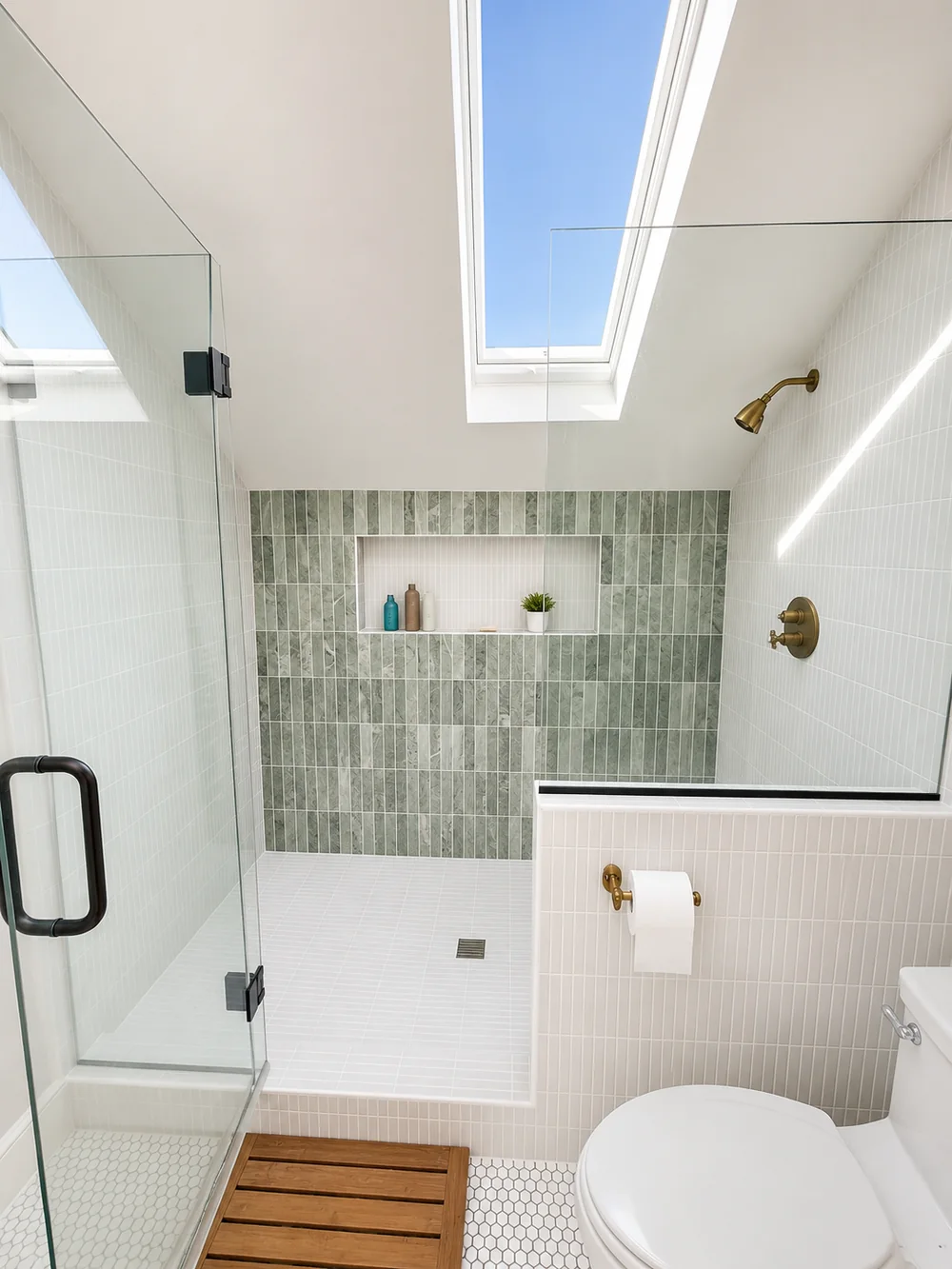
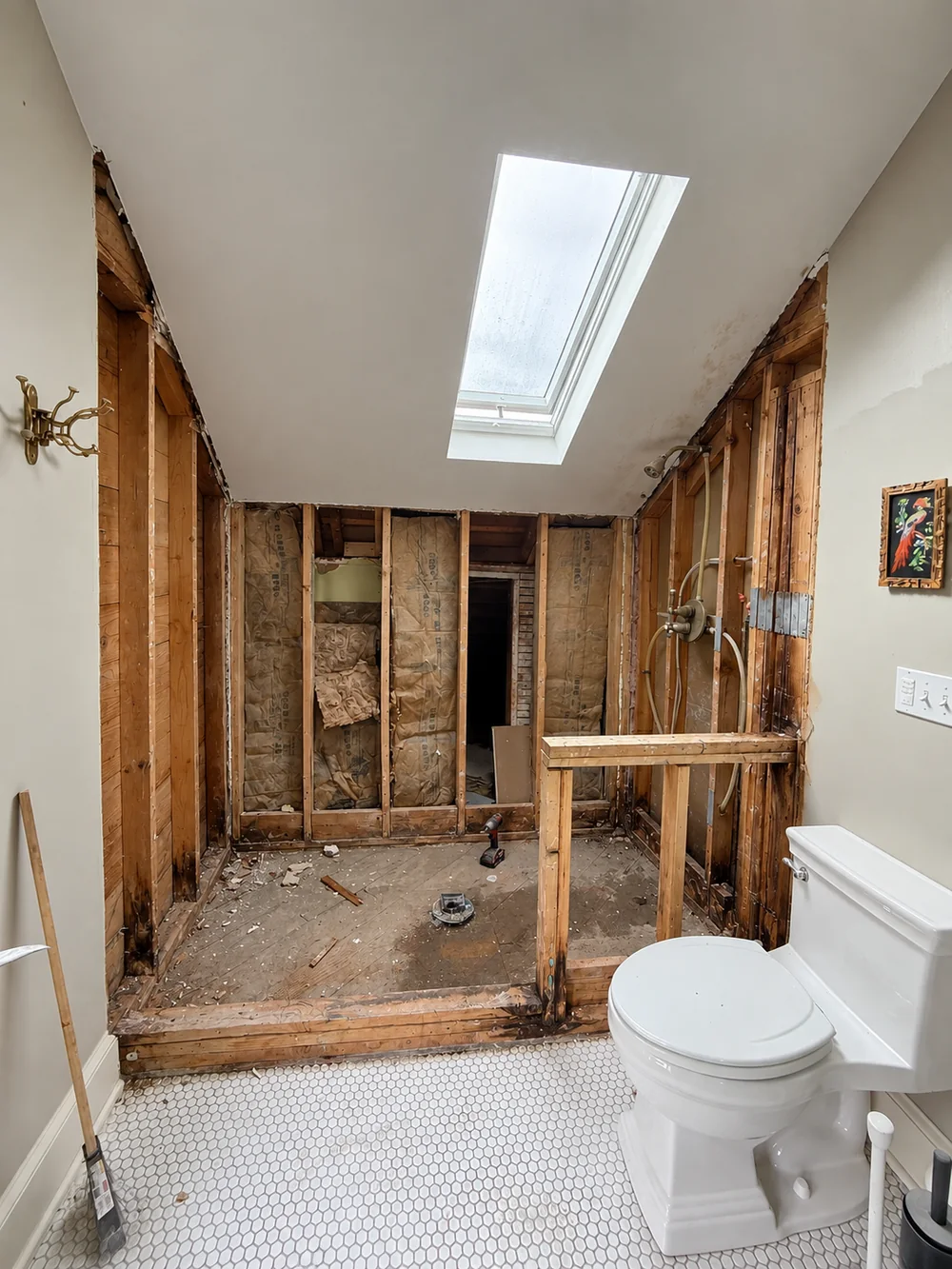 Before After
A soft spot you can press with a thumb is not where the trouble started. It is simply where the rot finally ran out of material to move through. Decay travels along the wood grain behind paint and siding for years, invisible the whole time, before it ever reaches a surface anyone would notice from the sidewalk. Because a Fairview house built during the city’s late 1980s through 2000s building years tends to share the same construction details as the one next door, that gap between what shows and what is actually happening runs fairly consistent from house to house across the city. Even so, we open the wall and look before putting a number on paper, since consistent is never the same thing as certain.

In the mid-1980s, the City of Fairview attempted something far bigger than its size suggested: an annexation of a large stretch of unincorporated land across eastern Multnomah County, a move that would have instantly made Fairview a city of roughly 120,000 people, second only to Portland anywhere in the state. Oregon law required two cities to jointly initiate a consolidation that size, and only Fairview moved forward with it, so the Oregon Supreme Court struck the attempt down in September 1985. The city never got its 120,000 residents, but the ambition of that decade lines up almost exactly with when Fairview’s real housing boom actually hit: most homes here date from the late 1980s through the 2000s, so the siding, the trim and the flashing on most of what is standing today went up in the years after that failed annexation push. A smaller, quieter city than it once imagined being, but one where a large share of the original exterior work is now aging through that same narrow window at close to the same time.
Half of any rot repair is just removing what has failed. The harder half, and the part that actually keeps us from returning to this same spot in another decade, is choosing a replacement that fits what is already on a Fairview house from this one tightly clustered building era.
What is already on the wall decides where we start, since an obvious patch job is a failed repair no matter how structurally sound it is underneath. A Fairview home from the late 1980s or 1990s building wave typically wears one of a short list of builder-grade siding and trim products common to that era, which makes tracking down a close current match a quicker exercise here than it would be in a city where homes span a hundred years of different materials. Where a specific profile has gone out of production entirely, we build it up from stock lumber until the reveal and the shadow line disappear into the boards running on either side.
Four separate questions actually decide how large a Fairview rot repair turns out to be, and the first two are things you can check yourself, on your own time, with nothing more than a flathead screwdriver.
First, does the piece in question actually carry weight? A run of casing, a water table, or the lowest course of siding holds nothing up, so a soft stretch of it is a quick, inexpensive fix. A rim joist, a post base, a sill plate, or the ledger connecting a deck to the house is a different matter entirely, since the structure is physically resting on it, which calls for temporary shoring, lumber rated for real load, and a permit filed directly with the City of Fairview rather than any county office, since Fairview has handled its own permitting since incorporating back in 1908.
Second, how far back does the soft wood actually reach? Instead of guessing from the visible stain, we work a thin blade along the grain in small steps, stopping only once it meets real resistance for a few consecutive inches, then push the check a little further still just to be safe. Rot moves through the fiber long before it ever shows from outside, and stopping exactly at the edge of what is visible is the single most frequent reason a homeowner ends up calling us back out a second time.
Third, would a filler actually hold up here? Rarely, as it turns out. A quality epoxy consolidant genuinely rescues a piece sitting in a shallow pocket of decay, nothing more, and it has no business anywhere near something that carries weight. We will not reach for it just to dodge opening a wall that genuinely needs opening.
Fourth, and the question that actually decides whether the fix lasts, is what put the water there to begin with. Close to Fairview Creek or the lower ground toward Blue Lake, standing water sitting at grade is usually the real cause, not wind. Elsewhere in the city, on higher, drier ground, it is just as often a gutter that has gone unclean for a season too long, or a downspout dumping straight against the foundation. Either way, we track that source down and close it off before any new wood goes back in, priced alongside the repair rather than tacked on after the fact.
Nobody, us included, can put a firm number on this before the wall or the deck is actually open, since the real cost follows how much hidden rot is back there, not the house’s square footage or the year it happens to have been built. A handful of things do hold true going in. Anything that stays confined to trim or a short run of deck boards tends to land cheap no matter where in the city the house sits. Once a post base, a rim joist, or a sill plate turns out to be involved, the number tends to climb, since that scope brings a City of Fairview inspection and temporary shoring along with the carpentry itself. Given how closely Fairview’s housing stock clusters in age, what moves the price most is rarely the house’s particular quirks. It is simply how many rainy seasons that one leak has already gotten away with running unnoticed. If you already have a written number from another company, hand it over with your photos and we will typically match it or beat it by 10 percent, in writing.
10%
Forward that figure to us together with a photo of the problem area. We will weigh it against our own number and reply the same afternoon, provided it lands with us ahead of 5pm.
Rot repair stays almost entirely on the exterior shell of a house, so a Fairview household keeps its ordinary routine running while the crew works through the week. Here is roughly how that week tends to break down.
Before a single board comes off, we walk the property together, flag which sections are coming out, and figure out, given the layout of your particular lot, where the crew’s gear, the staged lumber, and the dumpster all make the most sense to park for the duration. Whatever is breakable and sits close to that wall gets relocated first, either by you or by us.
The crew works through the morning stripping away old siding and trim, and by early afternoon the framing underneath is finally visible, usually in close to the same condition we have already seen on a handful of other Fairview homes from that same stretch of years. What that open framing actually looks like, rather than the estimate written beforehand, is what tells us whether the job stays small or grows.
If what turns up behind the wall runs worse than the number we quoted, we call you that same afternoon with photographs in hand, before the saw comes back out. Anything marked as a possibility on your estimate stays untouched until you have told us how you want to proceed.
Replacement framing and sheathing take the place of whatever came out, and the crew keeps going until both flashing and house wrap are locked down over the new work, since an overnight rain finding its way into an open stud bay would simply undo the repair before it even cures. On the rare day a storm wins the race, the opening gets sheeted over and sealed at the edges until the weather lets us pick back up.
Siding panels go back into place first, trim follows after, and the day’s exterior work wraps with a run of sealant and the first coat of primer. The house already looks finished from the curb at that point, and on a block where most homes share a similar age, that is often the first outward sign to the neighbors that any work happened at all.
Paint genuinely comes last in this sequence, not before. With that coat finally down, the crew sweeps every cut scrap and the old rotted wood out of the yard, then we go through the finished repair together, checking it against what the estimate originally promised, before the dumpster pulls away.
Push a thumbnail or the tip of a key into the spot that concerns you rather than trusting how it looks. Wood that is still sound resists and barely takes a mark, while wood that has actually failed gives way easily and often feels cool or faintly damp underneath. Because so much of Fairview was built within the same stretch of years, most of what we test is finished in a similar factory-primed siding or trim product, so a chalky, faded surface on its own tells you very little. The push test tells you the rest. Send a photo either way, and anything that reaches us before 5pm gets a real answer that same day.
Occasionally, yes, that single board really is the full extent of it, and we will tell you plainly rather than padding the scope. What usually decides the answer is not where in Fairview the house sits, since most of the city shares a similar construction era, but how long water has actually been working behind that particular spot. Before pricing anything beyond what you pointed out, we open enough of the wall to find exactly where the soft wood stops.
It can, and when it does, you hear about it immediately, with pictures attached, rather than finding it tucked into the final bill. We hold off on anything past that point until you have told us how to proceed. Fairview’s housing stock clusters tightly around the same late 1980s through 2000s building years, so the surprises we find tend to look alike from one job to the next, a flashing detail or a sealant joint common to that era failing the same way it did a few streets over.
Usually not without some specific triggering event. Carriers tend to file slow, weather-driven wood rot in the same category as a worn-out water heater or an aging roof, routine upkeep rather than a covered loss. That changes if something sudden and datable caused it, a pipe that burst overnight, or a windstorm that tore a section of flashing loose. Either way, we keep a dated record, photographs and measurements, as the wall or deck comes open, which gives you something solid to bring to an adjuster if you decide it is worth filing. The actual coverage decision rests with your insurance company, not with us.
We are, any time the job actually touches something that carries weight, a rim joist, a post base, a sill plate, or a deck ledger among them. Fairview has handled its own permitting since incorporating back in 1908, so that filing goes straight to the City of Fairview rather than to Multnomah County, and we hold Oregon CCB #262707 to handle it and meet the inspector ourselves. A repair confined to cosmetic trim or siding, nothing load-bearing involved, typically skips the permit step entirely.
A repair confined to trim or siding is typically done within a day, occasionally running into a second. Once a post base, a sill plate, or a rim joist is actually part of the scope, plan on closer to a week, since shoring the structure, ordering lumber that matches, and getting a City of Fairview inspector scheduled all take their own time regardless of how quickly the carpentry itself moves. We will give you a real number only once the wall is actually open in front of us.
Usually without much difficulty, and often more easily here than in a city where houses span a hundred years of different materials. A Fairview home from that late 1980s through 1990s stretch is typically finished in one of a short list of builder-grade siding and trim products common to the era, so the first step is simply confirming which exact product is already on the wall. When that specific profile is no longer produced, we build it up from stock lumber until the reveal and shadow line disappear into the boards running beside it.
No, almost certainly not. Fairview has carried its own city charter since 1908, but it stayed a small, quiet place for most of the decades that followed, and most homes here date from the late 1980s through the 1990s and into the 2000s. So the age that actually matters for a rot call is not how long the city itself has existed but that one tightly clustered fifteen- to twenty-year building window nearly everything standing today came out of.
The crew’s shop is at 505 SE 184th Avenue in east Vancouver, WA. Getting to Fairview means a straightforward hop across the Columbia on I-205, then a short stretch east on I-84, landing in the city before that highway ever reaches Wood Village or Troutdale just beyond it, so a job out here fits into a normal week rather than a special trip. We cover the whole city, from the blocks nearest Blue Lake Regional Park and Salish Ponds out toward the Fairview Creek side of town, on homes from the same late 1980s through 2000s building wave that makes up most of what is standing. We hold Oregon CCB #262707.
Three of the 50 reviews on our Google profile, in the homeowners' own words.
David's work was terrific. Repaired a rotted out structural framing issue in a bathroom and replaced (and resized!) a window in the same space. He initially quoted a two day job but was able to finish in a single day. Dedicated! Will be using him again.
Joe H.Bathroom framing repair
We talked to 4 different contractors and only David, of Evergreen, took the time to climb up to our roof to check out the job. The others gave us bids based upon a photo. Evergreen was not the cheapest but the extent of the work they did was worth every penny.
Steve K.Roof and exterior work
Evergreen crew installed three skylights for us. Once we opened the ceiling there was more to do than expected and they handled it without drama. Clean work, fair price, and they cleaned up after themselves.
Foad M.Three skylights
Send photos and a short description. If it arrives before 5pm you get an answer the same day.
Already have a written estimate from someone else? Send that too. We match or beat most estimates by 10%.
Built for the wet side of the river.

Licensed and insured remodeling contractor serving Vancouver, WA and the Portland metro.
Oregon CCB #262707 · WA Lic. #EVERGRS757MCEvergreen Renewal Services LLC
505 SE 184th Ave Unit 320
Vancouver, WA 98683
© 2026 Evergreen Remodeling. Oregon CCB #262707 · WA Lic. #EVERGRS757MC. Evergreen Renewal Services LLC. All rights reserved.
Same day response on anything sent before 5pm.