

What keeps the crew booked
Water gets into wood quietly, and this part of the metro gives it more chances than most. Gresham sits right where the valley floor starts climbing into the Cascade foothills, which pushes our yearly rain total several inches past what falls across Portland, somewhere around 47 to 48 inches most years. On the ranch and split-level houses that fill the streets west of downtown and through Rockwood, roof overhangs were built shallow and the original windows were set single pane, so exterior walls take weather with very little cover above them. We trace the path the water actually followed, open the framing back to solid fiber, and rebuild whatever carries weight before anything new goes back over it. It is the call we answer more than any other.
Licensed and insured. Oregon CCB #262707
On anything sent before 5pm
We match or beat most written estimates
Remodels completed
With close to four feet of rain landing most years and the Cascades starting to rise just east of town, water has plenty of time to work into every seam a house owns. On the ranch and split-level homes common across Gresham, these are the points it reaches first, and the ones we end up opening most:
These pieces meet the weather before anything else does: a corner board gone soft where it meets the ground, the trim ringing each window and door, the water table and belly band running the wall, and whatever sheathing is hiding underneath once they are pulled.
Deck boards that have gone spongy, the joists and beams holding them up, and the ledger bolted into the house framing, the single hardest-working connection on the whole structure. Mature maples and firs common to these older lots drop leaves and needles across a deck most of the year, and the moisture trapped under that litter usually reaches the ledger first.
Rim joists, sill plates, studs and post bases that have spent years pulling moisture out of saturated ground, which in the lower blocks near the Johnson Creek drainage can mean a crawlspace that never fully dries out between one storm and the next.
Flashing around an original window or door that quit doing its job years back, so every storm rolling off the foothills has been finding a way behind the trim ever since. On a wall with barely a few inches of overhang above it, there is nothing up there to slow that water down first.
A supply line or shower pan that has been seeping quietly for months inside a compact original bathroom, turning the subfloor and the joists beneath it soft long before a tile cracks or a toilet starts to rock underfoot.
Send a couple of photos and a line about what caught your eye. Reach us before 5pm and you get an answer that same day, and if it turns out to be outside what we handle, we will tell you plainly and point you toward whoever can.
On rot work this is the only proof that means anything. A finished photo shows a wall. A pair shows what was behind it.
Drag the handle. The before shot shows the shower opened down to the studs and subfloor once the leak was traced. The after shot shows the same alcove closed in, waterproofed and tiled.
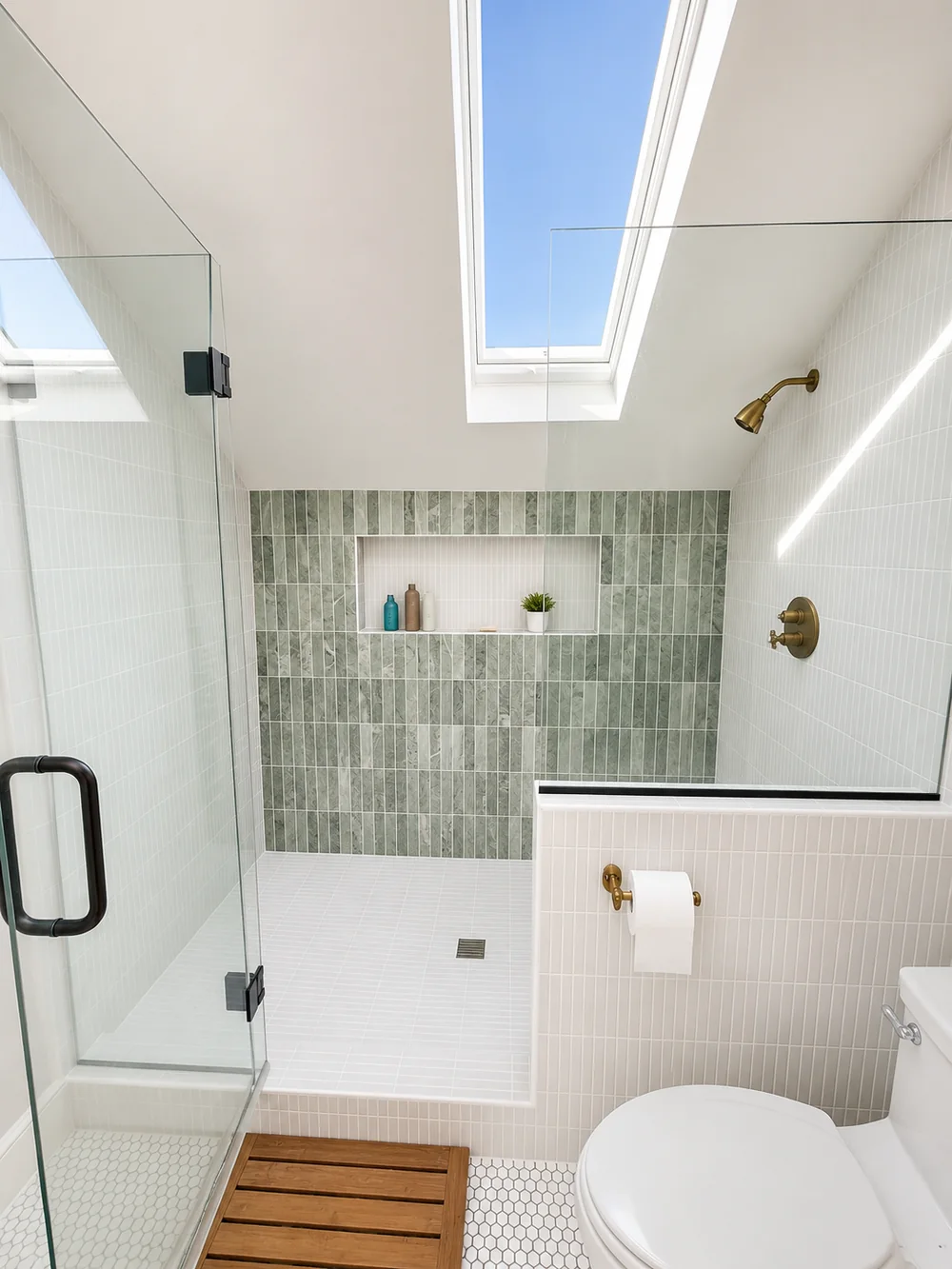
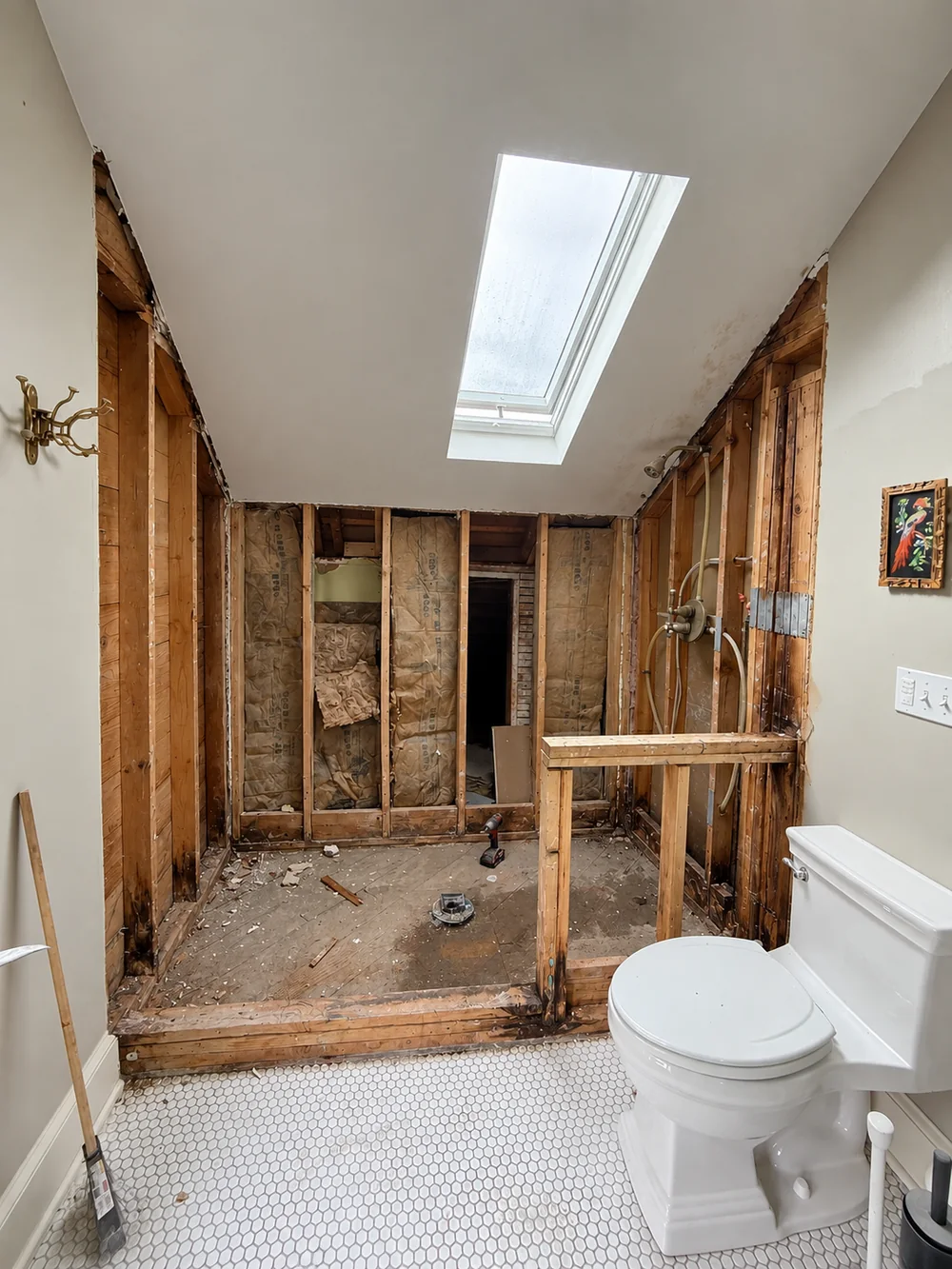 Before After
What shows from the driveway is almost never where the damage started. Rot travels inside the grain long before paint tells on it, and on these ranch-style walls built with narrow eaves, the gap between the visible soft spot and the actual source of the leak can run a surprising distance up or down the wall. A number written off a photo is really a number written off a guess, and that guess turns into a change order the first afternoon the siding comes off.
That is why we look the wall over in person before anything gets priced. We separate what can be confirmed standing outside from what only shows once the siding is open, and the estimate is built the same way, a firm number for the confirmed work and a clearly marked allowance for whatever the opening reveals, one you approve before a single additional cut is made. You always know which figure is locked in and which one is still a question.


Gresham sits close enough to the foothills that storms wring out more rain here than they do a few miles west, year after year. On the ranch and split-level homes built through the 1960s to 1990s, that extra moisture has had a long run at whatever trim and siding came with the original build.
Pulling the bad wood out is the fast half of this job. The half that decides whether we are back at this same corner in another decade is what we choose to put in its place.
We start by figuring out what the house is already wearing, not what is easiest to install. A ranch home west of downtown with its original cedar corner boards gets cedar back, cut to the same profile; if that exact shape has not been milled in years, we build it up from square stock until the reveal and shadow line disappear into the run on either side.
Durability in cedar and redwood comes from oil locked into the heartwood, and the sapwood cut into boards sold today carries very little of that same protection compared with old growth. Primed finger-jointed pine is the inexpensive route and holds a paintbrush well, but it turns punky fast anywhere moisture sits, which under a shallow overhang in a wet climate is most of the wall, so we keep it clear of grade and off the lowest run of trim. Cellular PVC and fiber cement never rot at all, which is exactly why they earn a spot at the chronic failure points, the base of a corner board, a water table, casing beneath a window that was never flashed properly at the head. Paying more per linear foot there buys you out of doing this twice.
Framing gets judged on its own terms. Anything bearing on concrete or sitting close to the dirt comes back pressure-treated, since plain fir set against a damp foundation is exactly how the original sill plate failed in the first place. Where a joist needs sistering or a stud needs swapping, Douglas fir carries the load, sized and fastened to shoulder what the old piece shouldered, not merely enough to fill a gap.
Hardware deserves more attention than it typically gets. Copper in modern treated lumber will chew through plain galvanized steel in a single wet season, so anything driven into treated stock or cedar comes in stainless or hot-dipped galvanized instead. Drive an ordinary screw into cedar and black streaks weep down the face before the year is out, and no coat of paint will ever hide that afterward.
Every piece gets a full coat of primer on every side, including the cut ends, before it is ever fastened into place. Raw end grain pulls moisture the way a sponge does, and whether that single step actually happens is a better predictor of how long a repair lasts than the brand name on the paint can.
Four things determine how big this job really turns out to be, and you can work out the first two yourself this weekend with nothing more than a flathead screwdriver.
Does the piece actually hold weight? Trim, a water table, the bottom run of siding: none of that carries the house, so a bad length is an afternoon lost and nothing more serious. A rim joist, a sill plate, a post base or a deck ledger is a different matter entirely, because the structure leans on it, and that calls for temporary shoring, lumber rated to carry a load, and a permit with an inspection through the City of Gresham Building Division. The dollar figure was never really about the board. It is about pulling a bearing piece free without anything settling while the work happens.
How far has the softness traveled? Work a screwdriver along the board every couple of inches until the tip quits sinking in, then keep testing another twelve inches past that point. Decay moves inside the fiber well ahead of anything visible from outside, and stopping at the edge of what you can see is the single biggest reason a repair fails and has to be redone.
Does epoxy belong in the plan? Now and again, and we will say so plainly. A good consolidant and filler can genuinely save a shaped piece that nobody mills anymore, a window sash, a porch post, an odd run of trim, provided the damage sits in a pocket and has not eaten clean through. None of that applies to anything load-bearing, and it is never a way around opening the wall. A contractor offering to pack epoxy into a soft sill plate is setting you up to pay for the same repair twice.
And what sits above the damage? That answer decides whether the fix actually lasts. The water started somewhere higher, a kickout flashing that was never installed where a roofline dies into a wall, a gutter that overshoots during a hard rain off the foothills, siding buried too deep into a planting bed, a deck ledger with nothing capping its top edge. We track that source down and close it before any new lumber goes in, priced on the same sheet, because wood installed under a leak that is still running gets paid for twice.
The honest answer is that price follows the extent of the damage, and extent is not something anyone can state with certainty until the wall or deck is actually open. A few things are true before that moment arrives. A contained repair, a stretch of trim or a handful of soft deck boards, sits near the bottom of the range. Bring a joist, a sill plate or a post base into the picture and the number climbs, because a bearing member means shoring and an inspection come along with it. What moves the figure most of all is simply how many wet seasons the leak has already had to work, and with close to four feet of rain falling most years here, the least expensive repair is always the one handled this fall instead of next spring.
Where the dollars actually land tends to catch people off guard. Lumber is usually the smallest line on a rot invoice. The real expense is labor and reach, building staging or working out a safe ladder plan, pulling siding back far enough to get behind the damage, holding a load on temporary posts while a bad member comes out, then closing the wall so nothing shows it was ever opened. Ten feet of bad trim under a shallow roofline costs more than double what the same ten feet costs at arm’s reach, and two small repairs on opposite corners of a ranch house add up to more than one larger patch handled in a single visit.
Roughly in order, you are paying for labor first, then the sealing that locks the repair in for good, flashing, house wrap, siding, primer and a finish coat, then the lumber itself, and last, a permit and inspection through the City of Gresham if the work touches anything structural. Anything that has to come down and go back up again lands on its own line, a downspout, a light fixture, a stretch of deck rail, a satellite mount, so you can see exactly which part of the number is wood and which part is getting to it.
Already holding a written estimate from someone else? Send it over. On most written quotes we will match the number or beat it by 10%, in writing.
10%
Send it over along with a photo or two of the trouble spot. Get it to us before 5pm and you will have an answer that same day.
Almost all of this work happens on the skin of the house rather than inside the rooms you actually use, so it ranks among the least disruptive remodels to have going on around a family’s routine. Here is roughly how the days unfold.
Before anything comes down, we walk the property together and mark exactly which sections are coming off, then figure out where the dumpster sits, where staging goes up, and where the lumber gets stacked, not always simple on an older lot carrying mature trees on a 6,000- to 8,000-square-foot footprint. Whatever could break near that wall gets carried somewhere safer first, either by your hands or ours.
This is the loud stretch. Siding and trim come off across the morning, and by early afternoon the framing is standing bare. Those open hours are what finally answer the question the estimate could only guess at, whether the possible-extent line on your paperwork turns out to be real.
Find something worse than priced once the framing is exposed, and you hear about it that same afternoon, photographs included, before another cut is made. Nothing sitting in the possible-extent column moves forward without your go-ahead.
Fresh framing goes up first, sheathing right behind it, and we do not call it a day until flashing and house wrap are also on, because leaving a stud bay open overnight in this climate is asking for the same problem to start over. On the rare day weather wins the race, we tarp and seal the opening tight until it passes.
Siding goes back on, then trim, then a bead of sealant and a first coat of primer. From the curb the house already reads finished at this stage, which is usually right around when someone from down the block wanders over to ask who is doing the work.
Last on the list is the topcoat. Once it’s dry we tidy the site, sweep up the yard, and go over everything with you line by line against what the estimate promised. Scrap lumber, the rot we pulled out, and the dumpster itself all ride off with the crew before we call it done.
Give it a firm push with a pocketknife or the tip of a screwdriver, somewhere a mark will not matter. Sound wood barely dents. Once rot has set in, the tool sinks in almost on its own, the fiber underneath feels like wet cardboard, and you will often see the paint lifting in small blisters at that exact spot before anything else looks wrong. Send a photo or two either way. Anything that reaches us before 5pm gets looked at the same day.
Sometimes that genuinely is the entire job, and when it is, that is exactly what we will tell you. But if the soft wood keeps traveling past the board you pointed at, we are not going to nail a new one over the top and call it finished. Hidden rot does not stop because it is covered. It keeps working through the framing behind the patch, and the second repair that follows almost always costs more than doing the job completely the first time would have.
It comes up often enough that we build the possibility into the quote rather than let it surprise you mid-project. One figure on the estimate covers whatever we can confirm from outside the wall. A second, clearly separate figure covers whatever the opening itself might reveal, and that second number sits untouched until you have reviewed our photos and told us to proceed.
That call belongs to your insurance carrier, since it rests on the wording of your particular policy and on what actually let the water in, not on anything a contractor can decide. What we bring to the table is a clean paper trail, photographs and written notes on everything we find the moment the wall or deck comes open, so if you do file a claim, the adjuster is looking at documented evidence rather than a secondhand description.
We do, any time the scope calls for one. Putting back a sill plate, a rim joist, a post base, or the framing under a deck is bearing work, and in Gresham that permit and its inspection come from the City of Gresham Building Division, not a county office. A wide clear span can call for engineered plans with a stamp. We carry an Oregon contractor license, CCB #262707, so filing the application and scheduling each inspection is on us. Plain cosmetic siding or trim, with nothing structural behind it, usually needs no permit at all.
A contained repair, a stretch of trim or a run of siding, usually wraps inside a day or two. Structural work takes longer, because temporary shoring, the city inspection, and drying the opening back in all have to land in the right order, and paint will not cure properly in wet weather. Your estimate spells out a day count up front. You do not need to be home for most of it, but keep your phone close on the day the wall opens, since that is when a decision about hidden damage, if there is any, lands with you.
In almost every case, yes. Lap siding, shingle courses and the common casing shapes are either still carried at the lumberyard or can be milled to order, and for a profile that has genuinely disappeared from the catalogs, we build one up from plain stock until the face and reveal line up with the boards on either side. Paint is the easier half of the match. Hand us the leftover can or its formula code and it goes quickly, and without either, we pull a color match straight off a chip taken from the wall.
The dry stretch from roughly July into September is the easier window, mainly because an opening does not have to stay exposed as long. That said, we take rot jobs on in every month of the year, closing each section back up against the weather as soon as it is finished rather than leaving the whole house open until Friday. Waiting for clear skies usually works against you, since the leak keeps running the entire time you put it off, and with Gresham averaging somewhere around 48 inches of rain a year, a small soft spot rarely stays small for long.
We run out of a shop at 505 SE 184th Avenue in east Vancouver, a straightforward run across the Columbia on I-205 and east through the Portland metro into Gresham, so a job out here is a normal day on the schedule for the crew, not a special trip. We take rot work across the whole city, from the ranch and split-level streets west of downtown and through Rockwood, out to the newer rooflines filling in around Pleasant Valley and the Springwater area, and up toward where Powell Boulevard turns into the Mount Hood Highway at the edge of town. Licensed in Oregon, CCB #262707.
Three of the 50 reviews on our Google profile, in the homeowners' own words.
David's work was terrific. Repaired a rotted out structural framing issue in a bathroom and replaced (and resized!) a window in the same space. He initially quoted a two day job but was able to finish in a single day. Dedicated! Will be using him again.
Joe H.Bathroom framing repair
We talked to 4 different contractors and only David, of Evergreen, took the time to climb up to our roof to check out the job. The others gave us bids based upon a photo. Evergreen was not the cheapest but the extent of the work they did was worth every penny.
Steve K.Roof and exterior work
Evergreen crew installed three skylights for us. Once we opened the ceiling there was more to do than expected and they handled it without drama. Clean work, fair price, and they cleaned up after themselves.
Foad M.Three skylights
Send photos and a short description. If it arrives before 5pm you get an answer the same day.
Already have a written estimate from someone else? Send that too. We match or beat most estimates by 10%.
Built for the wet side of the river.

Licensed and insured remodeling contractor serving Vancouver, WA and the Portland metro.
Oregon CCB #262707 · WA Lic. #EVERGRS757MCEvergreen Renewal Services LLC
505 SE 184th Ave Unit 320
Vancouver, WA 98683
© 2026 Evergreen Remodeling. Oregon CCB #262707 · WA Lic. #EVERGRS757MC. Evergreen Renewal Services LLC. All rights reserved.
Same day response on anything sent before 5pm.